

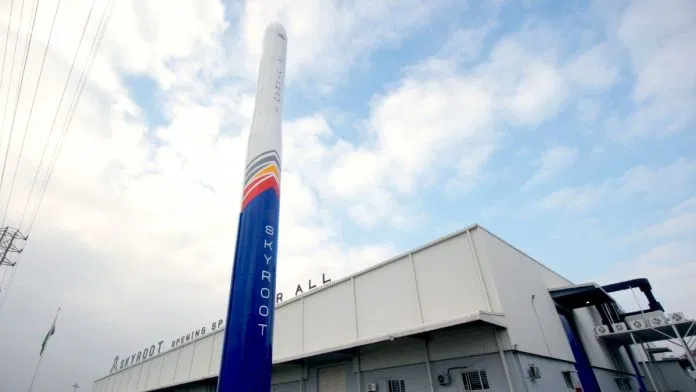
India has entered a new era in space exploration. On July 18, 2026, Hyderabad-based Skyroot Aerospace successfully launched Vikram-1, making it the first privately developed Indian rocket to reach Earth orbit. The achievement marks a major milestone not only for the company but also for India’s rapidly expanding private space ecosystem.
The successful mission, named Mission Aagaman, lifted off from the Satish Dhawan Space Centre, Sriharikota, and placed multiple customer payloads into a 450-km Low Earth Orbit (LEO). The launch was briefly delayed by a 35-minute hold due to a technical check, but the mission proceeded flawlessly thereafter.
What is Vikram-1?
Vikram-1 is a 22-metre-tall, three-stage small satellite launch vehicle designed to carry payloads of up to 350 kg to Low Earth Orbit and around 260 kg to Sun-Synchronous Orbit. Developed by Skyroot Aerospace, it is intended for the growing global market for small satellite launches.
One of the rocket’s biggest technological highlights is its use of 3D-printed rocket engines, carbon-composite structures and advanced avionics, allowing faster manufacturing and lower launch costs. These innovations position Skyroot as a competitive player in the commercial launch industry.
From Vikram-S to Vikram-1
Skyroot first made headlines in 2022 when it launched Vikram-S, India’s first privately built suborbital rocket. That mission demonstrated the company’s core technologies but did not achieve orbit.
With Vikram-1, Skyroot has taken the next major step by successfully placing payloads into orbit on its very first attempt, a feat that few private space companies worldwide have achieved.
Why This Mission Matters
The success of Vikram-1 is significant for several reasons:
●It is India’s first privately developed orbital launch vehicle.
●It demonstrates the growing capabilities of Indian private space startups following the government’s 2020 space sector reforms.
●It strengthens India’s position in the global commercial satellite launch market.
●It showcases indigenous deep-tech innovations, including additive manufacturing and lightweight composite materials.
The mission also places India among a select group of nations where private companies have independently developed and launched orbital rockets.
PM Modi Congratulates Team Skyroot
Prime Minister Narendra Modi congratulated Skyroot Aerospace on the historic achievement, calling it a proud moment for India’s innovation ecosystem. He said the success would inspire young innovators and strengthen the country’s ambitions in the global space economy. During a later address, he also praised the young engineers behind the mission, highlighting India’s growing startup culture.
The Road Ahead
Skyroot is already looking beyond Vikram-1. The company plans additional launches of the rocket to begin commercial operations and is developing Vikram-II, a more powerful launch vehicle capable of carrying heavier payloads. It is also working on reusable rocket technology, a step that could significantly reduce launch costs in the future.
India aims to expand its space economy from about $8 billion today to $44 billion by 2033, with private companies expected to play a central role. The success of Vikram-1 is likely to attract greater investment, accelerate innovation and encourage more Indian startups to enter the space sector.
More than just a successful launch, Vikram-1 represents the beginning of a new chapter, one where Indian private enterprise stands alongside ISRO in shaping the country’s future in space.