

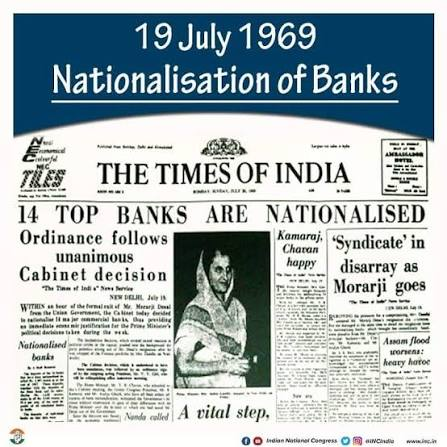
On the midnight of July 19, 1969, the Government of India, led by then Prime Minister Indira Gandhi, nationalised 14 major commercial banks, each with deposits exceeding ₹50 crore. Announced without prior warning, the move marked one of the most significant economic policy decisions in independent India’s history, fundamentally transforming the country’s banking system.
The Reserve Bank of India (RBI) later described the decision as “the single most important economic decision taken by any government since 1947,” noting that “not even the reforms of 1991 are comparable in their consequences—political, social and, of course, economic.”
According to the RBI, the objective was to ensure that major scheduled commercial banks operated in line with national development priorities rather than primarily serving large industrial and business interests.
Why Were Banks Nationalised?
The decision was formally announced on July 20, 1969, with the government stating that banking needed to support broader socio-economic development.
The key objectives included:
- Expanding banking services to rural and underserved areas.
- Increasing institutional credit for agriculture.
- Supporting small-scale industries and entrepreneurs.
- Promoting financial inclusion.
- Reducing the concentration of financial power among a handful of private business groups.
Indira Gandhi described the move as “a vital step” toward aligning the banking sector with national development goals.
Expansion of Public Sector Banking
Bank nationalisation significantly expanded the reach of formal banking across the country, particularly in rural India.
In the years that followed:
- Public sector banks increased to 22.
- They accounted for nearly 84% of total bank deposits.
- Around 82% of bank branches across India came under the public sector.
The expansion of branch networks helped bring banking services to millions of people who previously had little or no access to formal financial institutions.
Political Background
The decision came during a period of intense political struggle within the Congress party.
Indira Gandhi was engaged in a power tussle with the influential Congress Syndicate, and bank nationalisation was widely viewed as both an economic reform and a politically significant move that strengthened her pro-poor image following the Congress party’s setbacks in the 1967 General Election.
Then Finance Minister Morarji Desai, who opposed the proposal, was removed from the Finance Ministry before the announcement.
Parliamentary Approval
The Banking Companies (Acquisition and Transfer of Undertakings) Bill was passed by the Lok Sabha on August 4, 1969, after an extended sitting that lasted several hours beyond schedule.
Besides transferring ownership of major banks to the government, the legislation also introduced provisions for greater employee participation in the management of public sector banks, including representation on advisory committees and boards constituted in consultation with the RBI.
Second Phase in 1980
A second round of bank nationalisation took place in 1980, during Indira Gandhi’s third term as Prime Minister, when six more commercial banks were brought under government ownership, further strengthening the public sector’s dominance in Indian banking.
Lasting Legacy
More than five decades later, the 1969 bank nationalisation remains one of the defining moments in India’s economic history. While economists continue to debate its long-term impact on efficiency and competition, the decision is widely acknowledged to have played a pivotal role in expanding banking services, promoting financial inclusion, and extending institutional credit to rural India and priority sectors.