

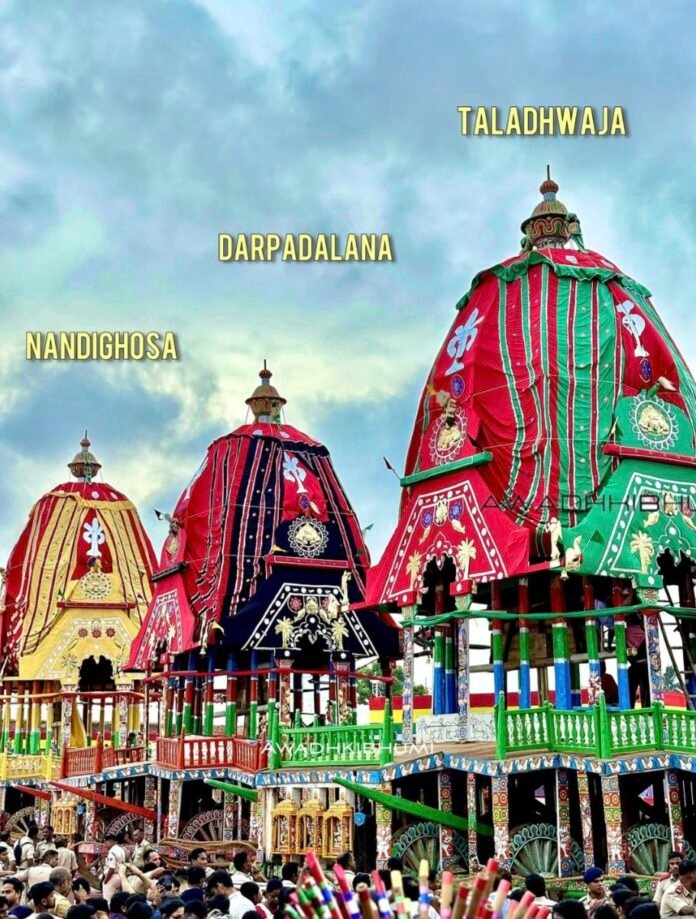
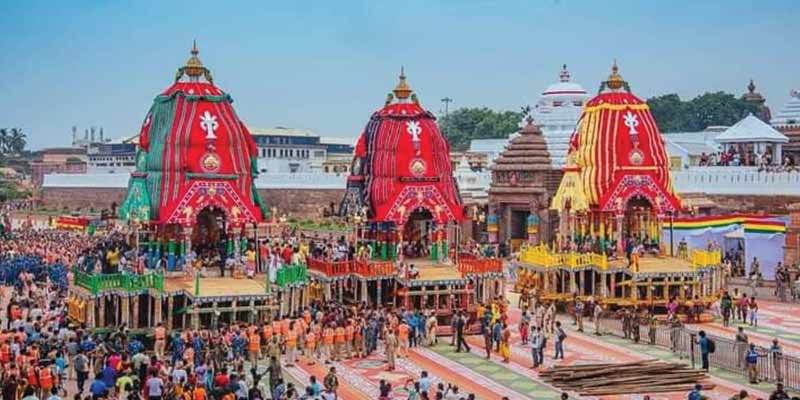
At the heart of the Jagannath Rath Yatra lies one of the world’s most remarkable engineering and spiritual traditions, the construction of three magnificent wooden chariots that carry Lord Jagannath, Lord Balabhadra, and Devi Subhadra from the Jagannath Temple to the Gundicha Temple in Puri, Odisha.
To the millions who gather every year, these towering rathas are far more than ceremonial vehicles. Each has its own name, dimensions, colours, wheels, horses, guardian deities, and profound symbolism. Built anew every year by hereditary artisans using sacred neem and other specified woods, the chariots follow precise measurements and rituals that have been preserved for centuries.
Together, they represent not only the divine journey of the three siblings but also the rich spiritual philosophy of the Jagannath tradition.
Nandighosha: The Chariot of Lord Jagannath
The largest and most imposing of the three chariots is Nandighosha, which carries Lord Jagannath, revered as the Lord of the Universe.
Standing about 45 feet (13.7 metres) tall, Nandighosha is built on a square platform and rests on 16 wooden wheels, each measuring roughly seven feet in diameter. It is the tallest of the three chariots, symbolising Lord Jagannath’s universal presence and supreme status.
Its canopy is decorated in red and yellow, colours associated with spiritual illumination, prosperity, and divine energy. The chariot is traditionally drawn by four white horses named Shankha, Balahaka, Suweta, and Haridashwa, representing purity, strength, and the victorious movement of dharma.
The chariot bears the Trailokyamohini flag, whose name means “the Enchanter of the Three Worlds.” At its front stands Garuda, the celestial eagle and vehicle (vahana) of Lord Vishnu, symbolising devotion, courage, and protection.
Nandighosha is regarded as a symbol of the cosmos itself, with Lord Jagannath at its centre, guiding humanity towards righteousness and liberation.
Taladhwaja: The Chariot of Lord Balabhadra
Lord Balabhadra, the elder brother of Jagannath, rides on Taladhwaja, the second-largest chariot.
Measuring approximately 44 feet (13.4 metres) in height, Taladhwaja rests on 14 wheels, slightly fewer than Nandighosha. Its canopy is adorned in red and green, colours representing fertility, balance, agriculture, and the nurturing forces of nature.
The chariot is pulled by four black horses named Tibra, Ghora, Dirghasharma, and Swarnanava. These horses symbolise determination, endurance, and steadfast strength—qualities closely associated with Lord Balabhadra, who is revered as the embodiment of physical power, agriculture, and protection.
Its flag is known as Unnani, while the guardian figure at the front is often identified as Vasudeva. The name Taladhwaja, meaning “Palm Tree Banner,” is traditionally linked to the palm tree, a symbol of resilience and steadfastness.
Spiritually, Taladhwaja represents strength guided by wisdom, reminding devotees that true power lies in humility, discipline, and service.
Darpadalana: The Chariot of Devi Subhadra
The smallest of the three chariots is Darpadalana, also known as Devadalana or Padmadhwaja, which carries Devi Subhadra, the sister of Jagannath and Balabhadra.
Standing around 43 feet (13.1 metres) tall, it is built on 12 wooden wheels, reflecting harmony and completeness. Its canopy features red and black, colours that signify divine energy, protection, mystery, and the feminine cosmic power (Shakti).
Darpadalana is drawn by four red horses named Rochika, Mochika, Jita, and Aparajita. Their vibrant colour symbolises vitality, courage, and the active energy of the Goddess.
The chariot flies the Nadambika flag and is traditionally associated with Jayadurga, a protective form of the Divine Mother.
The name Darpadalana literally means “Destroyer of Pride.” It signifies the triumph of humility over ego and teaches that devotion requires surrender rather than arrogance.
Built Anew Every Year
One of the most extraordinary aspects of the Rath Yatra is that all three chariots are rebuilt from scratch every year.
Construction begins on Akshaya Tritiya, using timber sourced from designated forests in Odisha. The work is undertaken by hereditary families of carpenters, sculptors, painters, and artisans who have preserved these sacred techniques for generations.
The dimensions, number of wheels, colours, carvings, and decorative motifs are prescribed by centuries-old temple traditions and remain remarkably consistent year after year. Once the annual festival concludes, the chariots are ceremonially dismantled, symbolising the cyclical nature of creation, preservation, and renewal.
More Than Chariots
The three Rathas are not merely architectural marvels, they are moving temples and living symbols of India’s spiritual heritage.
Together, Nandighosha, Taladhwaja, and Darpadalana embody different aspects of the divine: Lord Jagannath represents universal compassion and liberation, Lord Balabhadra stands for strength and righteousness, while Devi Subhadra symbolises compassion, harmony, and divine feminine energy.
As thousands of devotees pull the massive chariots through the streets of Puri, they are not simply moving wooden structures. They are participating in a centuries-old tradition that reflects equality, devotion, craftsmanship, and the enduring belief that the divine comes out to meet humanity.
The sight of the three majestic Rathas rolling together remains one of the most iconic images of Indian culture, a celebration where architecture, faith, mythology, and community come together in a journey that continues to inspire millions across the world.