

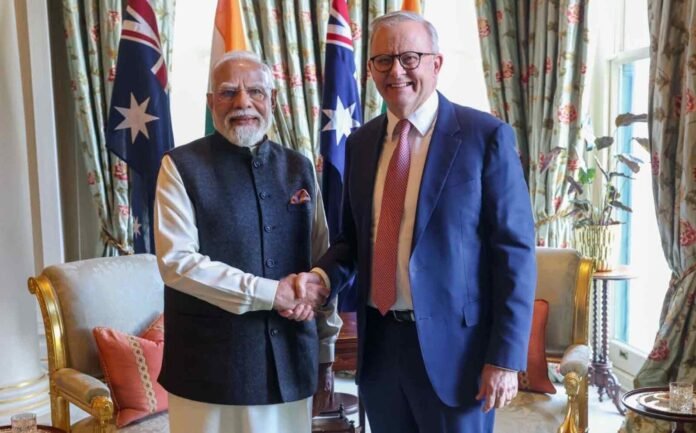
Prime Minister Narendra Modi concluded his state visit to Australia with a series of landmark agreements and initiatives that significantly elevated the India–Australia Comprehensive Strategic Partnership. Held from July 8–10, the visit focused on strengthening defence and security cooperation, clean energy, critical minerals, trade, education, technology, sports and people-to-people ties. A total of 18 major outcomes emerged from the visit, reflecting the growing strategic convergence between the two Indo-Pacific democracies.
New Defence and Security Declaration
A key highlight of the visit was the adoption of a Joint Declaration on Defence and Security Cooperation (JDDSC), replacing the 2009 framework and laying out an ambitious roadmap for deeper military collaboration.
The declaration commits both countries to expanding defence industrial cooperation, increasing joint military exercises, enhancing maritime domain awareness, strengthening intelligence sharing and improving interoperability between their armed forces. India and Australia also reaffirmed their commitment to a free, open, inclusive and rules-based Indo-Pacific, while expressing support for international law and freedom of navigation.
Civil Nuclear Cooperation and Uranium Supply
One of the most significant outcomes was the operationalisation of the long-pending civil nuclear cooperation agreement through an administrative arrangement that will enable Australia to export uranium to India for peaceful civilian nuclear purposes.
The move is expected to support India’s ambitious target of expanding nuclear energy capacity while strengthening Australia’s role as a reliable supplier of critical energy resources.
Critical Minerals and Clean Energy
Recognising the importance of resilient supply chains, both nations agreed to deepen cooperation in critical minerals, including lithium and rare earth elements that are essential for electric vehicles, batteries and clean energy technologies.
The leaders also expanded collaboration in renewable energy, hydrogen, clean technologies and climate action, aiming to accelerate the transition towards sustainable energy systems.
Boost to Trade, Technology and Innovation
Prime Ministers Narendra Modi and Anthony Albanese reaffirmed their commitment to expanding bilateral trade and investment under the India–Australia Economic Cooperation and Trade Agreement (ECTA) while working towards a Comprehensive Economic Cooperation Agreement (CECA).
The two countries agreed to strengthen cooperation in emerging technologies such as artificial intelligence, quantum technologies, semiconductors, cybersecurity, space, digital innovation and advanced manufacturing. They also pledged closer collaboration in resilient supply chains and trusted technology partnerships.
Education, Skills and Mobility
Education remained another important pillar of the partnership. Both sides announced new initiatives to promote academic collaboration, research partnerships, student exchanges and mutual recognition of skills and qualifications.
The leaders also discussed enhancing mobility for students, researchers and skilled professionals, reflecting the growing educational and people-to-people linkages between the two countries.
Sports Diplomacy
Adding a unique dimension to the bilateral relationship, India and Australia unveiled an India–Australia Roadmap for Sports Collaboration. The initiative aims to facilitate cooperation in sports science, athlete development, coaching, sports administration and major sporting events.
Prime Minister Modi also visited the iconic Melbourne Cricket Ground (MCG), highlighting cricket’s role as a strong cultural bridge between the two nations.
Diaspora Engagement
During his visit, Prime Minister Modi addressed a large gathering of the Indian diaspora in Melbourne, thanking the Indian community for serving as a “living bridge” between the two countries.
The event celebrated the contribution of the Indian diaspora to Australia’s economy, education, innovation and multicultural society, while reinforcing the close people-to-people ties that underpin the bilateral relationship.
A Shared Vision for the Indo-Pacific
In their joint statement, Prime Minister Modi and Prime Minister Albanese reaffirmed their commitment to strengthening cooperation through regional platforms including the Quad, while supporting peace, stability and prosperity across the Indo-Pacific.
Both leaders stressed the importance of respecting sovereignty, territorial integrity and international law, while agreeing to work together on maritime security, disaster resilience, counter-terrorism and regional connectivity.
Looking Ahead
Prime Minister Modi’s Australia visit marked one of the most consequential phases in India–Australia relations. From defence and civil nuclear cooperation to critical minerals, technology, education and sports, the visit produced a comprehensive set of outcomes that broaden the scope of the bilateral partnership.
As both countries navigate evolving geopolitical and economic challenges in the Indo-Pacific, the agreements reached during the visit reinforce their commitment to building a stronger, future-ready strategic partnership based on shared democratic values, economic resilience and regional security.