

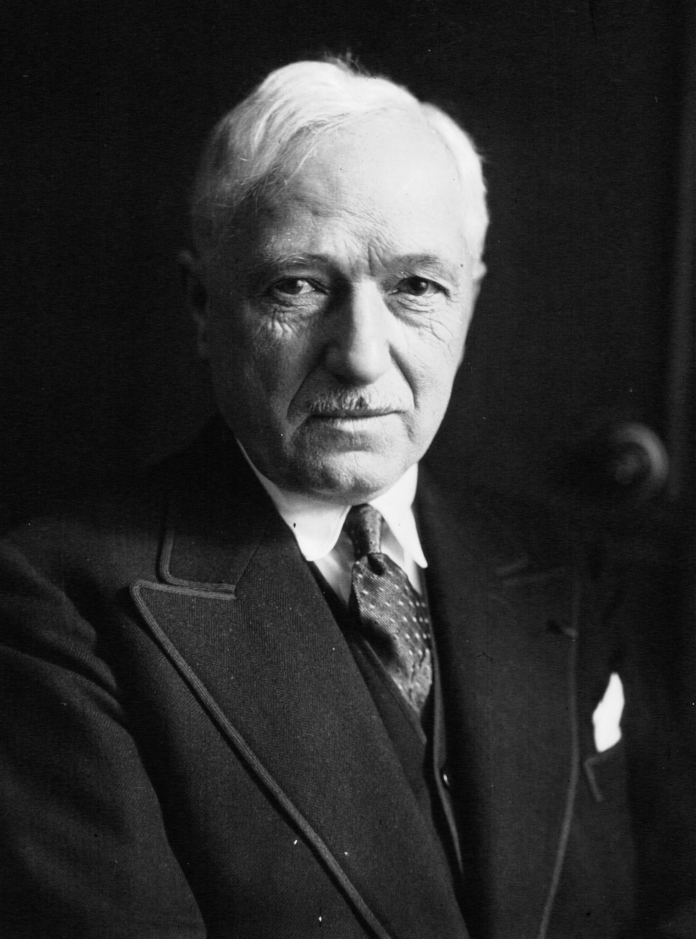
Every four years, billions of eyes turn toward a single golden prize, the FIFA World Cup Trophy. It is more than a piece of gold; it is the ultimate symbol of footballing glory. Yet few know that its remarkable story begins not with the trophy itself, but with one man’s impossible dream. That man was Jules Rimet. He envisioned that people should fight with a ball rather than a gun.
Jules Rimet: The Visionary Who United the World Through Football
In the early 20th century, international football lacked a truly global tournament. Clubs competed, nations played friendly matches, and the Olympics hosted football, but there was no championship dedicated solely to the world’s best national teams.
Jules Rimet believed football could unite countries beyond politics and borders. As FIFA President, he spent years convincing football associations that the world needed its own championship. His vision finally became reality in 1930, when Uruguay hosted the first-ever FIFA World Cup. To celebrate the tournament, FIFA unveiled its first World Cup trophy. It was initially called “Victory,” symbolizing triumph after fierce competition. Years later, FIFA renamed it the Jules Rimet Trophy, honoring the man whose determination gave birth to the world’s biggest sporting event.
A Goddess of Victory in Gold
The original trophy was designed by celebrated French sculptor Abel Lafleur. Rather than depicting footballers, Lafleur chose Nike, the ancient Greek goddess of victory, holding a golden chalice high above her head. Crafted from gold-plated sterling silver and resting on an elegant lapis lazuli base, the trophy stood just over a foot tall—but its symbolism was enormous.
When Uruguay lifted it in 1930 after winning the inaugural tournament, the Jules Rimet Trophy instantly became football’s greatest prize.
The Trophy That Survived a World War
The Jules Rimet Trophy soon became more than a sporting award, it became a historical artifact. During World War II, Europe was engulfed in conflict, and there were real fears that the trophy could be seized by Nazi forces. Italian football official Ottorino Barassi took an extraordinary risk to protect football’s greatest treasure.
Instead of storing it in a vault, he secretly hid the trophy inside a simple shoe box beneath his bed in Rome. For years, football’s most valuable prize remained hidden in an ordinary bedroom, escaping the chaos of war.
Without Barassi’s courage, the original World Cup trophy might never have survived.
The Day a Dog Saved the World Cup
The trophy’s most unbelievable adventure came in 1966, just months before England hosted the FIFA World Cup. Displayed proudly during a public exhibition in London, the Jules Rimet Trophy suddenly vanished. It had been stolen.
The disappearance sparked one of Britain’s biggest police investigations. Newspapers covered the mystery daily, yet detectives found no trace of football’s greatest prize. Then came an unlikely hero.
A black-and-white dog named Pickles was being walked through a South London neighborhood when he sniffed something unusual beneath a garden hedge. Wrapped in newspaper lay the missing World Cup trophy. Pickles instantly became an international celebrity, proving that sometimes history is rewritten not by detectives—but by dogs.
Brazil Earns the Trophy Forever
By 1970, one nation had established itself as football’s greatest powerhouse. Brazil, led by legends like Pelé, became the first country to win the FIFA World Cup three times, earning the permanent right to keep the Jules Rimet Trophy under FIFA’s rules. It seemed like the perfect ending to the trophy’s story. It wasn’t.
The Mystery That Remains Unsolved
In 1983, thieves broke into the headquarters of the Brazilian Football Confederation in Rio de Janeiro and stole the Jules Rimet Trophy once again. Unlike the London theft, there was no miraculous recovery. Despite years of investigation, the original trophy was never found. Authorities believe it was melted down and sold for its gold, bringing a heartbreaking end to one of sport’s most historic artifacts. The original World Cup trophy vanished forever.
A New Trophy for a New Era
Fortunately, FIFA had already prepared for the future. Even before Brazil permanently received the Jules Rimet Trophy, FIFA organized an international design competition for a new prize. Italian artist Silvio Gazzaniga created the now-iconic FIFA World Cup Trophy. Standing 36 centimeters tall and crafted from 18-carat solid gold, the sculpture depicts two human figures joyfully lifting the Earth, symbolizing football’s power to unite humanity. It perfectly reflected the global game Jules Rimet had imagined decades earlier. The new trophy made its debut at the 1974 FIFA World Cup, where West Germany became the first nation to lift it.
The Trophy That No One Can Keep
Unlike the Jules Rimet Trophy, today’s FIFA World Cup Trophy never belongs permanently to any country. Winning teams lift the original during the trophy presentation but later receive an official gold-plated replica, known as the FIFA World Cup Winners’ Trophy, to keep.
The original remains under FIFA’s protection and can only be handled by a select group that includes world champions, heads of state, and FIFA officials. One extraordinary exception came in 2010, when Nelson Mandela received an official replica ahead of South Africa’s historic World Cup.
Jules Rimet’s Greatest Legacy
More than ninety years after the first World Cup kicked off in Uruguay, Jules Rimet’s dream continues to inspire billions. From Pelé and Diego Maradona to Zinedine Zidane, Andrés Iniesta, and Lionel Messi, generations of football legends have lifted the golden trophy in moments that transcended sport. As the world looks toward the 2026 FIFA World Cup, hosted jointly by Canada, Mexico, and the United States, a record 48 nations will compete for football’s ultimate prize.
Yet every celebration, every triumphant captain raising the trophy toward the sky, still traces its origins back to one visionary Frenchman. Jules Rimet didn’t simply create a tournament. He created the world’s greatest sporting dream.