

When CM RISE School Vinoba, Ratlam, a government school serving students from an urban slum and tribal communities, was named the World’s Best School for Innovation 2024 by London-based T4 Education, it drew global attention to a remarkable educational transformation. Competing against schools from across the world, the school earned the prestigious honour for its innovative ‘Cycle of Growth’ model, which dramatically improved attendance, learning outcomes, teacher development, and community participation. Attendance rose from nearly 25% to over 85%, while examination pass rates increased from 29% to 82%, proving that meaningful change is possible even in resource-constrained government schools.
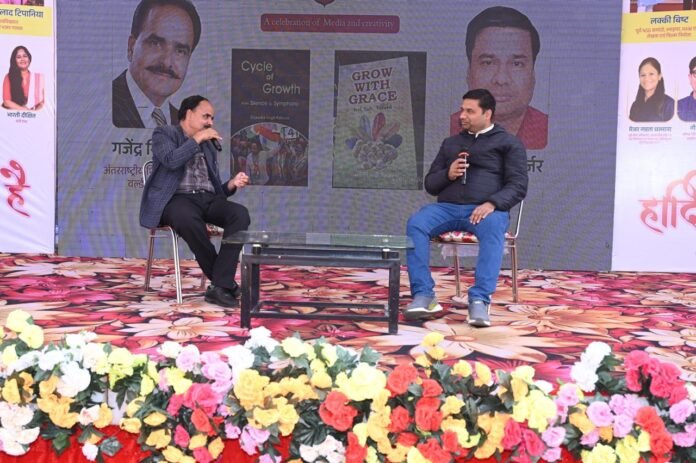
At the heart of this transformation is Gajendra Singh Rathore, one of the architects of the model and a key member of the school’s leadership team, who recently represented India at the World School Summit in the UAE. During an interaction at the Malwa Media Fest, Rathore spoke with Dr. Saurabh Gurjar about the philosophy behind the ‘Cycle of Growth’ and why he believes teachers, not technology or infrastructure, are the true drivers of educational excellence.
Q. What is the ‘Cycle of Growth’?
Rathore: Innovation begins by solving everyday challenges. In government schools, we repeatedly faced low attendance, poor academic performance, and weak engagement with parents and the community. The Cycle of Growth was developed to address these challenges by creating a culture of trust, continuous learning, appreciation, and shared responsibility.
Q. Who is at the centre of this model?
Rathore: The teacher. Teachers are the real change-makers. School leaders should focus on creating an environment where teachers feel respected, trusted, and motivated. Once teachers grow, students, parents, and the community naturally become partners in the school’s progress.
Q. How can schools build this culture?
Rathore: Appreciation should always be public, while feedback should be personal and constructive. We introduced ‘Huddle Time’, where teachers gather daily to celebrate successes, discuss challenges, and learn from one another. Initiatives like ‘Teacher of the Month’ further encourage excellence by recognising teachers’ contributions before the entire school community.
Q. What role do parents and the community play?
Rathore: Parents should first hear about their child’s strengths before discussing areas for improvement. At the same time, the community itself should become a classroom. Local artisans, mechanics, workshops, and skilled professionals offer real-life learning experiences that textbooks alone cannot provide.
Q. How should schools embrace technology?
Rathore: AI can help teachers prepare assessments and learning material, but it cannot replace a teacher. Education should focus on critical thinking, project-based learning, self-directed learning, and interdisciplinary teaching that connects classroom concepts with everyday life.
Q. What message did you share at the World School Summit?
Rathore: High performance means taking every child from survival to excellence. India already has exceptional teachers, especially in government schools. What they need is trust, opportunities to innovate, and leadership that empowers them to succeed.
Q. Your message to educators?
Rathore: Keep working with honesty and integrity. Practice what you preach. Lead with trust, love, and harmony. Educational transformation begins not with policies or buildings, but with teachers who believe in every child and inspire them to dream bigger.
A Model Beyond One School
Concluding the discussion, Rathore emphasised that the ‘Cycle of Growth’ is not merely a strategy for one institution but a replicable model for government schools across the country. Its global recognition demonstrates that world-class education does not depend on abundant resources, it depends on empowered teachers, collaborative leadership, engaged communities, and a shared commitment to helping every child move from survival to excellence.