

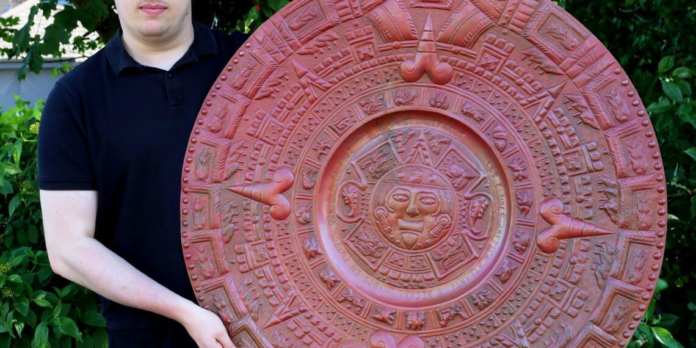
Before billion-dollar television deals, flashy bid presentations and digital campaigns decided the fate of the FIFA World Cup, football diplomacy relied on symbolism, personal relationships—and unforgettable gifts. Now, one of the most extraordinary relics from that era has resurfaced.
A magnificent 95-centimetre-wide copper disc depicting the fearsome Aztec sun god Tonatiuh, presented to FIFA president Sir Stanley Rous during Mexico’s campaign to host the 1970 FIFA World Cup—is set to go under the hammer after remaining out of public view for more than six decades. Auctioneers expect the historic artefact to fetch up to £35,000, though experts believe its unique place in football history could push the final bid much higher. More than just an artwork, the disc represents a defining moment in world football.
When Football Was Won in Boardrooms
In 1962, Mexico was locked in an intense contest with Argentina for the right to host football’s biggest tournament. Unlike today’s elaborate bid books and commercial pitches, international sporting politics often revolved around diplomacy, prestige and personal connections. The enormous repoussé copper disc, weighing around five kilograms, was gifted to Sir Stanley Rous by influential Mexican football administrator Guillermo J. Cañedo on behalf of clubs América, Atlante and Necaxa—the clubs closely associated with the construction of the legendary Estadio Azteca.
Its intricate design mirrors the famous Aztec calendar stone, with Tonatiuh’s commanding face at the centre surrounded by elaborate calendar rings and serpent motifs, blending Mexico’s ancient heritage with its modern sporting ambitions. Just two years later, FIFA awarded Mexico the right to host the 1970 World Cup.
The Tournament That Changed Football Forever
The decision transformed football history. Mexico 1970 became one of the sport’s most iconic tournaments. It showcased Pelé’s legendary Brazil side lifting their third World Cup, introduced millions of viewers to football through colour television broadcasts, and elevated the majestic Estadio Azteca into one of the game’s most revered venues. Many historians still regard it as the greatest World Cup ever staged.
A Museum-Quality Football Treasure
David Wilson-Turner, sporting specialist at Hanson Auctioneers, calls the disc “one of the greatest discoveries” of his career. He describes it as a museum-quality object directly connected not only to FIFA’s highest office but also to the political negotiations that shaped one of football’s greatest spectacles. He also notes how dramatically football governance has changed.
“A gift of this scale to the FIFA president today would immediately invite scrutiny,” he observes. “In the early 1960s, however, football diplomacy was conducted through prestige, symbolism and personal relationships.”
A Remarkable Journey
After Sir Stanley Rous, the disc passed into the possession of FIFA press officer René Courté, a close friend of the former president. It remained hidden for decades before emerging from Courté’s estate, making its first public appearance in over 60 years.
Today, as football has become a multi-billion-pound global industry, the remarkable artefact serves as a reminder of a different era—when an ancient Aztec symbol became part of the story that helped bring the world’s greatest sporting event to Mexico and forever changed the beautiful game.