

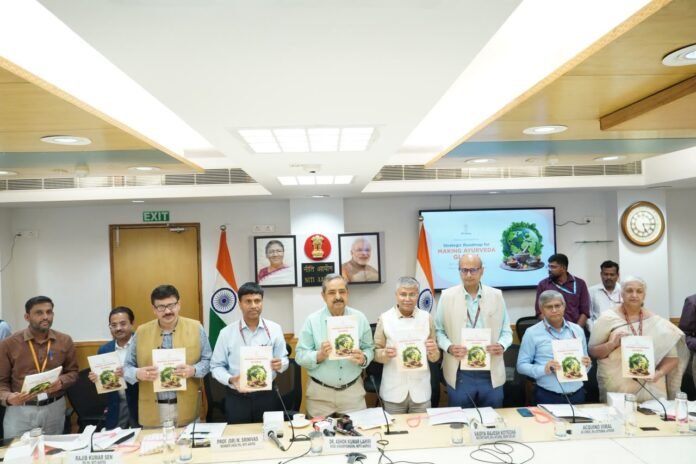
In a significant step towards positioning India’s traditional knowledge systems on the global stage, NITI Aayog has released a landmark report titled “Strategic Roadmap for Making Ayurveda Global.” The report lays out a comprehensive vision to transform Ayurveda from a largely India-centric traditional medical practice into a globally recognised, evidence-based healthcare system by 2047, in line with the vision of Viksit Bharat@2047.
Launched by NITI Aayog Vice Chairman Dr. Ashok Kumar Lahiri in the presence of Member Dr. M. Srinivas, Ministry of Ayush Secretary Vaidya Rajesh Kotecha, and senior officials from the Ministries of Ayush and External Affairs, the report was prepared by NITI Aayog’s Health Division in collaboration with PricewaterhouseCoopers (PwC) after extensive stakeholder consultations and international benchmarking.
A Three-Pillar Strategy
The roadmap is built around three key pillars—Availability, Acceptability, and Propagation.
The Availability pillar focuses on expanding the global Ayurveda workforce, strengthening research and development, promoting exports and manufacturing, and establishing internationally standardised education and training programmes.
The Acceptability pillar seeks to improve regulatory compliance, scientific validation, international collaborations, insurance coverage, and cultural adaptability to facilitate Ayurveda’s integration into mainstream healthcare systems across the world.
The Propagation pillar recommends strategic global branding, stronger international visibility, promotion of medical value travel, and greater participation in global health organisations to enhance Ayurveda’s global presence.
Unlocking Economic and Healthcare Potential
According to the report, globalising Ayurveda presents an opportunity not only to improve healthcare outcomes but also to generate significant economic value for India. The report notes that exports of Ayurvedic products have nearly doubled from USD 1.09 billion in 2014 to USD 2.16 billion in 2023, with products now reaching around 150 countries. However, many of these exports are still marketed as dietary supplements rather than medicines due to regulatory barriers in foreign markets.
To address this, NITI Aayog recommends developing globally accepted quality standards, strengthening manufacturing practices, creating an export-oriented Ayurvedic pharmacopoeia, and facilitating international regulatory approvals for Ayurvedic medicines. The report also proposes establishing a Global Ayurveda Register, promoting mutual recognition of practitioners, and expanding academic partnerships with universities worldwide.
Building Global Confidence Through Evidence
The report emphasises that Ayurveda’s global acceptance must be driven by robust scientific evidence, high-quality clinical research, and internationally recognised standards. It advocates greater collaboration between academia, industry, healthcare institutions, and governments to strengthen research, innovation, and evidence generation.
It also highlights the growing international interest in traditional medicine, supported by initiatives such as the WHO Global Centre for Traditional Medicine in Jamnagar, Gujarat, which has strengthened global engagement with evidence-based traditional healthcare systems.
Supporting India’s Soft Power
Speaking at the launch, NITI Aayog Vice Chairman Dr. Ashok Kumar Lahiri described Ayurveda’s globalisation as an opportunity to establish India as a leader in traditional medicine while creating employment, boosting exports, and enhancing the country’s cultural and knowledge-based soft power. Dr. M. Srinivas stressed that the initiative is ultimately aimed at improving health outcomes by offering people around the world additional evidence-based healthcare options.
A Vision for 2047
The report envisions Ayurveda becoming an integral part of healthcare systems worldwide by the time India celebrates 100 years of Independence. By strengthening research, education, regulation, manufacturing, exports, and international partnerships, the roadmap seeks to position Ayurveda as a credible, evidence-based system of medicine that complements modern healthcare.
As global interest in preventive healthcare, wellness, and holistic medicine continues to grow, the roadmap signals India’s ambition to transform one of its oldest knowledge traditions into a globally recognised pillar of healthcare—reinforcing the vision of “One Earth, One Health” while showcasing India’s rich medical heritage on the world stage.