

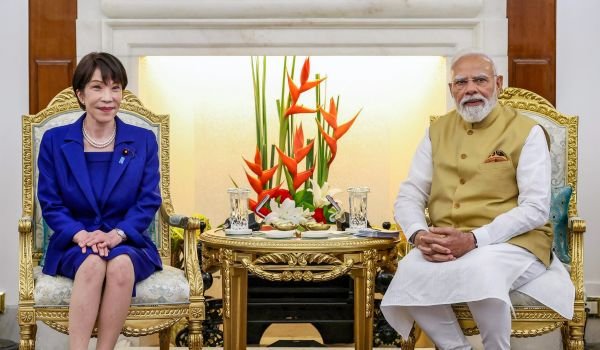
India and Japan have reaffirmed their long-standing strategic partnership with the announcement of 16 key outcomes following bilateral talks between Prime Minister Narendra Modi and Japanese Prime Minister Sanae Takaichi in New Delhi. Covering areas ranging from defence and semiconductors to high-speed rail, clean energy, digital technologies, and people-to-people exchanges, the agreements underscore the growing depth and breadth of relations between the two Indo-Pacific partners.
Welcoming Prime Minister Takaichi on her first official visit to India since assuming office, Prime Minister Modi described India-Japan relations as a partnership that has “stood the test of time” and continues to be built on shared democratic values, mutual trust, and a common vision for a free, open, and inclusive Indo-Pacific.
A Partnership for the Future
The summit resulted in 16 outcomes, including agreements, memoranda of understanding, and joint initiatives aimed at strengthening cooperation across strategic and emerging sectors.
A major focus of the discussions was economic and technological collaboration. The two countries agreed to expand cooperation in semiconductors, resilient supply chains, digital technologies, artificial intelligence, clean energy, green hydrogen, and innovation, reflecting their shared commitment to building future-ready economies.
The leaders also reaffirmed their resolve to strengthen trade and investment, with Japan continuing to be one of India’s largest development and infrastructure partners. Japanese investments have played a significant role in sectors such as automobiles, manufacturing, industrial corridors, logistics, and urban infrastructure.
Defence and Indo-Pacific Cooperation
Recognising the evolving security environment in the Indo-Pacific, India and Japan reiterated their commitment to closer defence and maritime cooperation. The leaders agreed to enhance military exchanges, defence technology collaboration, and maritime security while reaffirming support for a rules-based international order, freedom of navigation, and peaceful resolution of disputes.
Both countries also emphasised the importance of working together through regional and multilateral platforms, including the Quad, to promote peace, stability, disaster resilience, and sustainable development across the Indo-Pacific region.
Infrastructure and Connectivity
Infrastructure cooperation remains a cornerstone of India-Japan relations. The two leaders reviewed progress on flagship projects such as the Mumbai-Ahmedabad High-Speed Rail (Bullet Train) Project and discussed accelerating implementation through continued technical and financial collaboration.
They also explored new opportunities in urban development, transport, smart cities, and sustainable infrastructure, reinforcing Japan’s role as a key partner in India’s modernisation efforts.
People-to-People and Cultural Ties
Beyond strategic and economic cooperation, the summit placed considerable emphasis on strengthening cultural, educational, and academic exchanges. Both leaders agreed to expand collaboration in higher education, skill development, tourism, language learning, and youth exchanges to foster stronger people-to-people connections.
Prime Minister Modi noted that the friendship between India and Japan extends beyond governments and institutions, rooted in centuries-old civilisational links and mutual respect between their people.
A Comprehensive Strategic Partnership
India and Japan elevated their relationship to a Special Strategic and Global Partnership in 2014, and cooperation has steadily expanded since then. From defence and infrastructure to technology, climate action, and supply chain resilience, the partnership has become one of the pillars of India’s engagement in the Indo-Pacific.
The outcomes of the latest summit signal both countries’ intent to deepen collaboration in areas critical to future economic growth and regional stability. As geopolitical and technological landscapes continue to evolve, India and Japan are positioning themselves as trusted partners committed to innovation, sustainable development, and a secure, rules-based international order.
With 16 new initiatives agreed upon, the summit marks another significant step in strengthening one of Asia’s most important bilateral relationships, reflecting a shared vision of prosperity, resilience, and long-term strategic cooperation.