

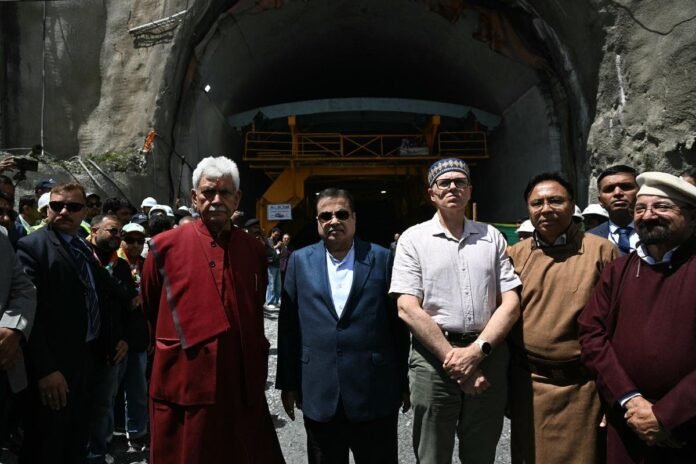
In a major milestone for India’s infrastructure and strategic connectivity, a significant breakthrough has been achieved in the construction of the Zojila Tunnel, one of the country’s most ambitious mountain infrastructure projects. The development brings India a step closer to establishing all-weather road connectivity between the Kashmir Valley and Ladakh, a region that remains cut off from the rest of the country for several months each year due to heavy snowfall.
The breakthrough was achieved on the main tunnel section beneath the formidable Zojila Pass, located at an altitude of over 11,500 feet. Once completed, the tunnel will transform travel across one of the most challenging stretches of the Himalayas and significantly reduce the hardships faced by residents, tourists, and security forces.
The Zojila Tunnel is being constructed on the Srinagar-Leh National Highway and will connect Baltal in Kashmir with Minamarg in Ladakh. With a planned length of approximately 13 kilometres, it is set to become India’s longest bi-directional road tunnel and one of the longest tunnels in Asia. The project is being developed by the National Highways and Infrastructure Development Corporation Limited (NHIDCL).
For decades, the Zojila Pass has been both a lifeline and a challenge. During winter, heavy snowfall often forces the closure of the pass, cutting off Ladakh from the Kashmir Valley for extended periods. This affects transportation, trade, tourism, healthcare access, and the movement of essential supplies. The tunnel is expected to eliminate these seasonal disruptions by providing year-round connectivity.
The project also carries immense strategic importance. Ladakh shares borders with both China and Pakistan, making reliable transportation infrastructure critical for national security. The tunnel will enable faster and safer movement of defence personnel, equipment, and supplies to border regions, strengthening India’s logistical capabilities in the Himalayas.
Beyond its strategic significance, the tunnel is expected to deliver substantial economic benefits. Improved connectivity is likely to boost tourism, create employment opportunities, facilitate trade, and enhance access to education and healthcare services in remote areas. Travel time across the Zojila stretch, which currently depends heavily on weather conditions, is expected to reduce dramatically once the tunnel becomes operational.
Constructing the tunnel has been an extraordinary engineering challenge. Workers and engineers have had to contend with extreme weather conditions, difficult geology, high altitudes, and limited working seasons. The successful breakthrough therefore represents not only a construction milestone but also a testament to modern engineering and human perseverance.
The Zojila Tunnel is part of India’s broader effort to improve connectivity in border and mountainous regions through tunnels, highways, bridges, and other strategic infrastructure projects. Similar initiatives in recent years have sought to make remote areas more accessible while supporting economic development and national integration.
As work progresses towards completion, the breakthrough at the Zojila Tunnel stands as a symbol of India’s determination to overcome geographical barriers. For the people of Ladakh, it promises greater connectivity and opportunity. For the nation, it represents another step towards building resilient infrastructure in some of the world’s most challenging terrain.