

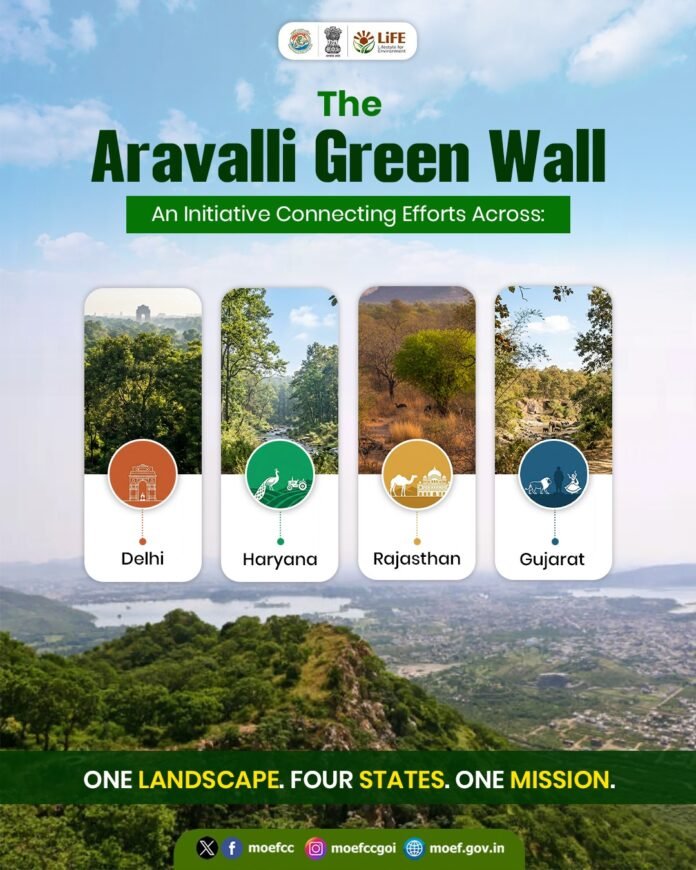
Stretching across four states and spanning some of India’s most ecologically significant landscapes, the Aravalli Green Wall Initiative is emerging as one of the country’s largest environmental restoration projects. Designed to combat desertification, restore degraded land, improve air quality, and revive groundwater systems, the initiative seeks to breathe new life into the ancient Aravalli mountain range, one of the oldest fold mountain systems in the world.
The project aims to restore nearly 2.7 million hectares of degraded land across Delhi, Haryana, Rajasthan, and Gujarat. At its core is the vision of creating a vast green ecological corridor stretching approximately 1,400 kilometres from Panipat in Haryana to Porbandar in Gujarat, helping reconnect fragmented ecosystems and strengthen the region’s environmental resilience.
The Aravallis play a crucial role in northwestern India’s ecology. They act as a natural barrier against the eastward expansion of the Thar Desert, support biodiversity, recharge groundwater, regulate local climate, and help reduce dust and air pollution affecting major urban centres, including Delhi-NCR.
However, decades of deforestation, unregulated mining, urbanisation, and land degradation have severely weakened the range’s ecological health.
Recognising the urgency of restoration, the Ministry of Environment, Forest and Climate Change has developed a comprehensive action plan under the Aravalli Green Wall Initiative. One of the most significant recent measures has been a stricter approach towards mining activities. Authorities have moved to restrict new mining leases in sensitive areas while strengthening protections against illegal extraction, long considered one of the biggest threats to the Aravalli ecosystem.
The initiative has also received attention at the highest judicial level. The Supreme Court has constituted an expert panel to examine issues related to the definition and protection of the Aravalli hills, investigate environmental violations, and recommend stronger conservation measures.
A key feature of the project is the use of technology-driven monitoring. More than 40 native plant species are being planted across restoration sites, with plantations being digitally geo-tagged and monitored through GIS mapping, satellite imagery, and the government’s Meri LiFE platform. This allows authorities to track plantation survival rates and assess long-term ecological outcomes more effectively.
Beyond tree planting, the initiative focuses on watershed development, soil conservation, groundwater recharge, biodiversity restoration, and community participation. Environmental experts believe that restoring natural vegetation and improving water retention could significantly enhance groundwater levels in several drought-prone regions while supporting local livelihoods.
The project also carries broader significance in the fight against climate change. Healthy forests and ecosystems absorb carbon dioxide, reduce land degradation, support wildlife habitats, and help communities adapt to changing climatic conditions.
While the challenges are immense, the Aravalli Green Wall represents a bold attempt to reverse decades of environmental decline. If implemented successfully, it could become a model for large-scale ecological restoration in India and beyond—demonstrating how science, technology, policy, and community action can come together to protect natural heritage and secure a more sustainable future.
At a time when environmental concerns are growing worldwide, the revival of the Aravallis is not just about restoring a mountain range; it is about restoring ecological balance for generations to come.