

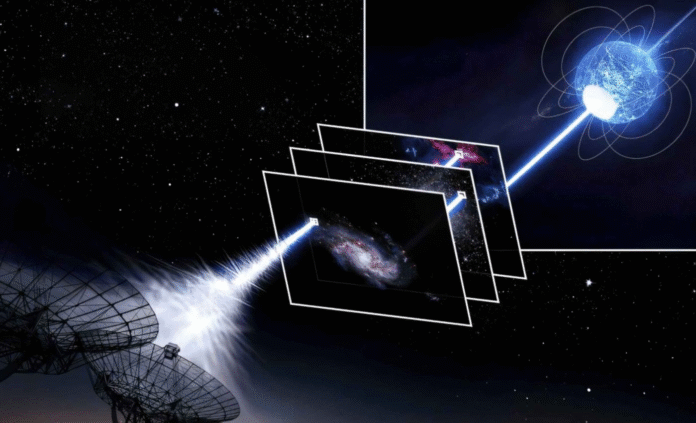
In a breakthrough that is exciting astronomers worldwide, scientists have detected a mysterious radio signal that journeyed across space for nearly 10 billion years before reaching Earth. The signal, identified as FRB 20240304B, was first captured on March 4, 2024, by the MeerKAT radio telescope in South Africa.
Researchers later used the James Webb Space Telescope (JWST) to trace the origin of the signal to a small, clumpy, low-mass dwarf galaxy actively forming stars. The discovery is being hailed as a major milestone in understanding the early universe.
What Are Fast Radio Bursts?
FRB 20240304B belongs to a mysterious class of cosmic phenomena known as Fast Radio Bursts (FRBs), extremely short but powerful flashes of radio waves emitted from distant regions of space. These bursts last only milliseconds yet can release enormous amounts of energy.
Astronomers study FRBs through factors such as dispersion measure, redshift, and host-galaxy localisation, which help reveal information about the material the signal crossed on its way to Earth.
A Glimpse into ‘Cosmic Noon’
Scientists say the burst originated when the universe was only around 3 billion years old, during an era called “Cosmic Noon.” This period, roughly 2–3 billion years after the Big Bang, marked the peak of star formation across the cosmos.
The detection of FRB 20240304B has doubled the redshift range of previously localised fast radio bursts, allowing astronomers to probe even deeper into the universe’s past.
Powerful Telescopes Behind the Discovery
The discovery relied on a combination of advanced observatories:
- MeerKAT (South Africa): A powerful radio telescope array that first detected the burst.
- James Webb Space Telescope: Operating in infrared wavelengths, JWST helped identify the host galaxy.
- LOFAR (Low Frequency Array): A European radio telescope network used for low-frequency astronomy.
Scientists believe some FRBs may originate from magnetars—highly magnetised neutron stars—though the exact source remains under investigation.
Another Deep-Space Discovery
In a separate finding, astronomers using LOFAR discovered a radio mini-halo surrounding the SpARCS1049 galaxy cluster, located about 10 billion light-years away and spanning more than one million light-years—further expanding humanity’s understanding of the universe.