

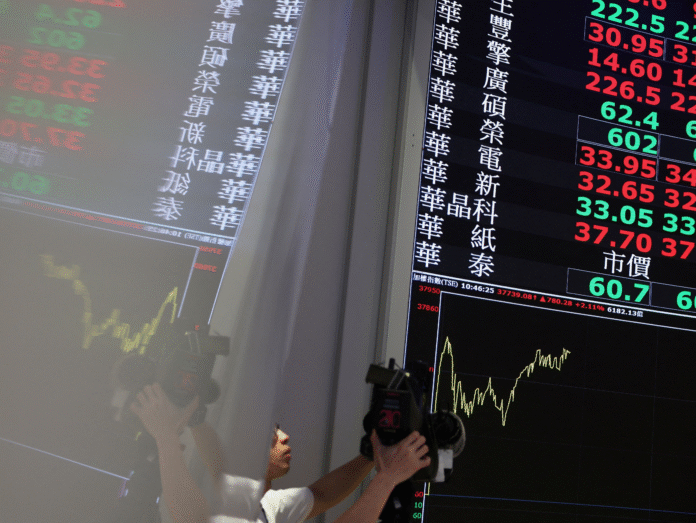
Taiwan became the world’s fifth-largest stock market on 25 May 2026 after its total market capitalisation climbed to US$4.95 trillion, overtaking India, whose market value stood at US$4.92 trillion.
The milestone was driven largely by a strong rally in Taiwan Semiconductor Manufacturing Co. (TSMC), the world’s largest contract chipmaker and the dominant force in Taiwan’s equity market. TSMC’s soaring share price boosted investor confidence and strengthened Taiwan’s position in global financial rankings.
Global Stock Market Rankings Shift
According to the latest market capitalisation rankings, the world’s largest stock markets are the United States, mainland China, Japan, Hong Kong, Taiwan, and India. Taiwan’s rapid rise has been notable in 2026, as it had already surpassed Canada and the United Kingdom earlier this year.
Analysts attribute Taiwan’s ascent to the growing global demand for artificial intelligence (AI) technologies, which has sharply increased investment in semiconductor companies. TSMC shares surged nearly 49% by 26 May 2026, fuelled by strong demand for AI chips used in data centres, graphics processing units (GPUs), and machine learning systems.
TSMC Drives Taiwan’s Market Boom
TSMC plays an outsized role in Taiwan’s financial markets, accounting for more than 42% of the country’s benchmark stock index. The company’s dominance has made Taiwan’s market highly concentrated, with broader market movements closely tied to the performance of the semiconductor giant.
The Taiwanese government also introduced regulatory changes that may further influence domestic investments. Taiwan’s financial regulator recently increased the investment ceiling for domestic funds in a single stock to 25% of net assets, a move expected to affect large institutional holdings in companies such as TSMC.
India Faces Market Pressure
Meanwhile, India’s stock market experienced pressure amid heavy foreign investor outflows in 2026. Analysts linked the decline in market value to elevated valuations, a weaker rupee, rising energy costs, and slower corporate earnings growth.
Foreign outflows — the net selling of domestic shares by overseas investors — have weighed on investor sentiment and reduced overall market capitalisation in recent months.
Important Financial Concepts
Market capitalisation refers to the total value of all listed shares in a company or stock market. It is calculated by multiplying a company’s share price by the number of outstanding shares.
A benchmark index is a standard stock index used to measure and track the performance of a stock market.
With AI-driven semiconductor demand continuing to reshape global markets, Taiwan’s emergence as a top-five stock market highlights the growing influence of chip manufacturing in the world economy.