

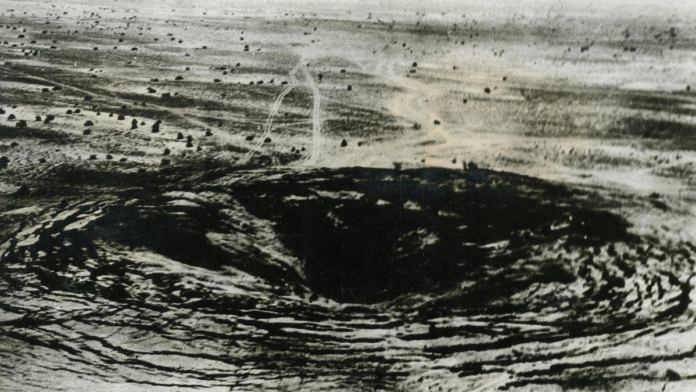
On 18 May 1974, deep beneath the sands of Rajasthan’s Thar Desert, India quietly announced its arrival among the world’s nuclear powers. The operation carried an unusual codename, Smiling Buddha, but its impact reshaped India’s strategic and scientific future forever.
The successful underground nuclear test at Pokhran marked a turning point in India’s post-independence journey. Conducted during the tenure of Prime Minister Indira Gandhi, the test demonstrated India’s growing scientific capability at a time when the global nuclear order was tightly controlled by a handful of nations.
The Desert That Made History
The remote Pokhran Test Range in Rajasthan was chosen for its isolation and geological suitability. Hidden beneath layers of desert rock, Indian scientists detonated a plutonium-based nuclear device in what the government officially described as a “Peaceful Nuclear Explosion.”
Despite the cautious terminology, the message to the world was unmistakable: India had become the sixth country capable of conducting a nuclear test, joining the ranks of the United States, the Soviet Union, the United Kingdom, France and China.
For a young nation still building its industrial and scientific base, the achievement symbolized technological self-reliance and strategic confidence.
Why the Codename “Smiling Buddha”?
The test took place on Buddha Purnima, the birth anniversary of Gautama Buddha, which inspired the codename Smiling Buddha. The contrast between the peaceful spiritual imagery and the immense destructive potential of nuclear technology made the name globally memorable.
Yet for India, the event was not only about military capability. It reflected decades of investment in atomic research led by pioneering scientists and institutions that envisioned nuclear technology as essential for national development, energy security and strategic autonomy.
Pokhran-II: India Declares Itself a Nuclear Weapons State
Twenty-four years later, Pokhran returned to global headlines.
In May 1998, India carried out a series of five nuclear tests under Operation Shakti, popularly known as Pokhran-II. Unlike the ambiguity surrounding the 1974 test, the 1998 explosions openly established India as a nuclear weapons state.
The mission brought together some of India’s most respected scientists, including A.P.J. Abdul Kalam, R. Chidambaram and Anil Kakodkar.
The tests triggered international sanctions and global debate, but they also transformed India’s strategic standing. Over time, India emerged as an accepted nuclear power with growing international partnerships in civilian nuclear energy.
National Technology Day: Celebrating Scientific Achievement
To commemorate the success of Pokhran-II, India observes National Technology Day every year on 11 May.
First celebrated in 1999, the day honours Indian achievements in science, engineering and innovation. It serves as a reminder that breakthroughs in technology often emerge from years of quiet research, institutional commitment and national ambition.
Today, the legacy of Pokhran extends beyond defence. It influences India’s expanding civil nuclear energy programme and broader technological aspirations.
India’s Nuclear Energy Future
India’s nuclear programme has now entered a new phase focused increasingly on clean energy and long-term sustainability.
In a major milestone, the Prototype Fast Breeder Reactor at Kalpakkam in Tamil Nadu achieved first criticality on 6 April 2026, advancing the second stage of India’s three-stage nuclear power programme. The development is significant because fast breeder technology can improve fuel efficiency and reduce long-term dependence on imported uranium.
India’s nuclear power capacity stands at nearly 9 GW in 2026, with an ambitious target of 100 GW by 2047. The expansion is closely tied to India’s commitment to achieving net-zero carbon emissions by 2070.
International interest in India’s civil nuclear sector is also growing. A delegation of senior executives from the American nuclear industry is visiting India from 18–21 May 2026 to explore cooperation opportunities following the enactment of the SHANTI Act.
Key Facts at a Glance
- India’s first nuclear test in 1974 was codenamed Smiling Buddha.
- Pokhran-II in 1998 was conducted under Operation Shakti.
- National Technology Day is observed on 11 May.
- India became the sixth nation to conduct a nuclear test in 1974.
- The Prototype Fast Breeder Reactor at Kalpakkam achieved first criticality on 6 April 2026.
- India aims to increase nuclear power capacity to 100 GW by 2047.
From the silent sands of Pokhran to ambitious clean-energy goals, India’s nuclear story is not merely about weapons or geopolitics. It is also a story of scientific ambition, technological confidence and a nation determined to shape its own future.