

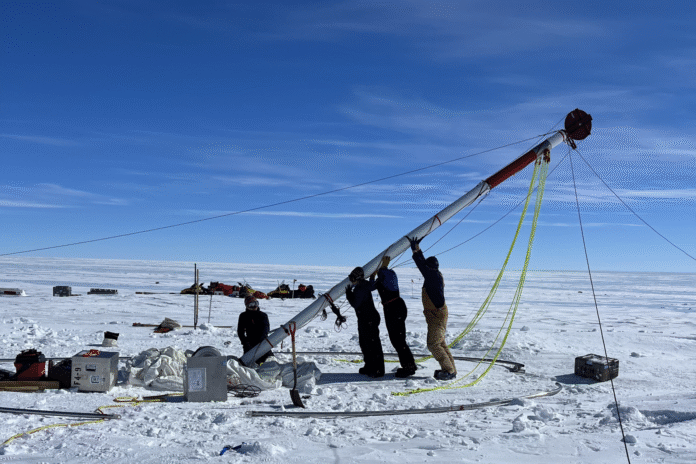
Scientists working in Antarctica have identified the oldest directly dated ice and air sample on Earth from the Allan Hills region of East Antarctica. The sample contains tiny air bubbles in 6-million-year-old ice and was dated through argon isotope analysis of trapped air.
Allan Hills Ice and Air Sample
The Allan Hills site lies in East Antarctica, a region known for ancient blue ice exposures. The sample from this area provides directly dated air, which is different from older climate records inferred from other proxies. The ice sample is 6 million years old and contains trapped air bubbles that preserve ancient atmospheric composition. The dating work found evidence of about 12 degrees Celsius of long-term cooling in Antarctica over the last 6 million years.
Scientific Institutions and Publication
The discovery was made by a team affiliated with the National Science Foundation-funded Center for Oldest Ice Exploration, also known as COLDEX. The study was led by Sarah Shackleton of Woods Hole Oceanographic Institution and John Higgins of Princeton University. The findings were published in the Proceedings of the National Academy of Sciences in late October 2025. The research used isotope measurements from argon in the trapped air bubbles to establish the age of the ice.
Beyond EPICA and Antarctic Ice Cores
The European Beyond EPICA–Oldest Ice project completed its final Antarctic campaign in May 2026. The project recovered a 1.7-mile, or 2.8-kilometre, ice core from Little Dome C in East Antarctica. This core dates back 1.2 million years and contains trapped air bubbles with greenhouse gases such as carbon dioxide and methane. The project involves 14 laboratories across 10 European countries and studies the Mid-Pleistocene Transition, when the rhythm of Earth’s ice ages changed.
Important Facts
- Antarctica is the coldest continent and contains the largest reserve of fresh water on Earth in the form of ice.
- Ice cores are cylindrical samples drilled from glaciers or ice sheets and are used to study past climate and atmospheric composition.
- Argon isotopes are used in geochronology because noble gases can remain trapped in ancient air bubbles.
- The Mid-Pleistocene Transition occurred roughly between 1.2 million and 0.7 million years ago and altered glacial cycles.
Directly Dated Air and Continuous Ice Records
The Allan Hills sample is the oldest directly dated air known from ice. The Beyond EPICA core is the longest continuous ice record recovered from Antarctica and serves a different scientific purpose.