

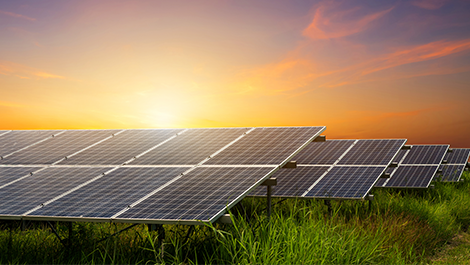
India has achieved a major milestone in its clean energy journey by crossing 150 gigawatts (GW) of installed solar power capacity after adding a record 44 GW in a single year. The achievement marks one of the fastest expansions of solar energy anywhere in the world and strengthens India’s position as a global renewable energy leader.
According to data released by the Ministry of New and Renewable Energy (MNRE), India’s total installed solar capacity reached around 150.2 GW by March 2026. The massive yearly addition of nearly 44.6 GW represents an increase of over 87% compared to the previous year, highlighting the rapid acceleration of the country’s green energy ambitions.
The growth has been driven by a combination of large-scale solar parks, rooftop solar installations and government-backed schemes. Programmes such as PM Surya Ghar, PM-KUSUM and the Production Linked Incentive (PLI) scheme for solar manufacturing have played a key role in boosting both solar adoption and domestic manufacturing capacity.
India is now the world’s third-largest producer of solar power, behind only China and the United States. Experts believe the latest achievement is significant not just for energy production, but also for climate action, energy security and economic growth. Solar energy reduces dependence on imported fossil fuels while helping India move closer to its target of achieving net-zero emissions by 2070.
A major contributor to this growth has been utility-scale ground-mounted solar projects. Rajasthan and Gujarat continue to lead the country in solar installations, with mega renewable energy parks transforming vast desert landscapes into power-generation hubs. Rajasthan’s Bhadla Solar Park remains one of the largest solar parks in the world.
At the same time, rooftop solar installations are expanding rapidly in urban and semi-urban India. The PM Surya Ghar scheme, launched to encourage households to install rooftop solar panels, has increased public participation in renewable energy generation. Farmers, too, are increasingly benefiting from solar-powered irrigation pumps under the PM-KUSUM scheme.
Despite the progress, challenges remain. Experts point to issues such as land acquisition, transmission infrastructure and dependence on imported solar components. However, the government’s push for domestic manufacturing through the PLI scheme is expected to reduce import dependence and strengthen India’s clean energy ecosystem.
India’s renewable energy expansion is increasingly being seen as both an environmental necessity and an economic opportunity. As global demand for clean energy technologies rises, the country is positioning itself not only as a major renewable energy consumer, but also as a future manufacturing and innovation hub in the green energy sector.