

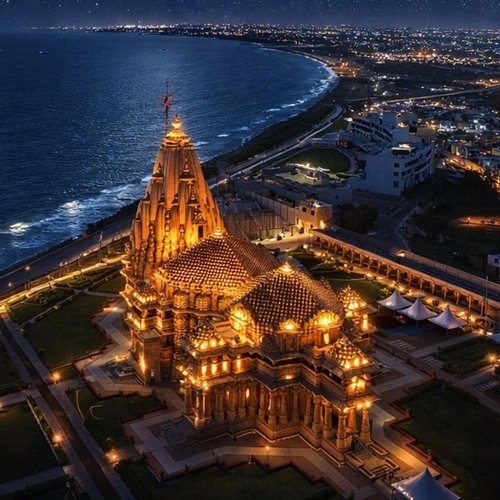
As the historic Somnath Temple marks 75 years of its post-Independence reconstruction, India is once again turning its attention to one of the country’s most enduring symbols of faith, resilience and civilisational continuity. Prime Minister Narendra Modi is set to participate in the “Somnath Amritparv 2026” celebrations on May 11, commemorating 75 years since the restored temple was inaugurated by India’s first President, Dr Rajendra Prasad, in 1951.
Located on the western coast of Gujarat at Prabhas Patan, Somnath is revered as the first among the twelve Jyotirlingas of Lord Shiva. But beyond its religious significance, the temple occupies a unique place in India’s historical and cultural consciousness. Over centuries, Somnath became a symbol of repeated destruction and repeated rebuilding — representing what many describe as the unconquerable spirit of Indian civilisation.
The year 2026 carries a double historical significance. It marks not only 75 years since the temple’s reopening after Independence, but also nearly 1,000 years since the first recorded attack on the temple by Mahmud of Ghazni in 1026. In January this year, the country observed the “Somnath Swabhiman Parv,” commemorating a millennium of resistance, survival and revival associated with the temple.
In recent remarks, Prime Minister Modi described Somnath as a “timeless symbol of Bharat’s resilience, unity and civilisational strength.” He noted that despite repeated invasions and destruction over centuries, the temple continued to rise again because of the enduring faith and collective resolve of the people.
The reconstruction of Somnath after Independence holds immense historical significance. Soon after India became free in 1947, Deputy Prime Minister Sardar Vallabhbhai Patel took the initiative to rebuild the temple as a symbol of national restoration and cultural self-confidence. The effort was strongly supported by writer and statesman K.M. Munshi. In May 1951, the rebuilt temple was formally inaugurated in the presence of President Rajendra Prasad.
The ongoing Amritparv celebrations include spiritual gatherings, cultural programmes, chanting ceremonies, exhibitions and events honouring those who defended the temple across centuries. Earlier this year, a grand “Shaurya Yatra” and a large drone show depicting Somnath’s historical journey drew national attention.
Today, Somnath stands not merely as a place of worship but as a powerful historical symbol — one that reflects India’s ability to endure adversity and reclaim its heritage. Its story continues to resonate because it is deeply intertwined with questions of faith, identity, memory and national pride.
From ruins to renewal, Somnath’s journey across centuries mirrors the larger story many associate with India itself — wounded repeatedly, yet never defeated.