

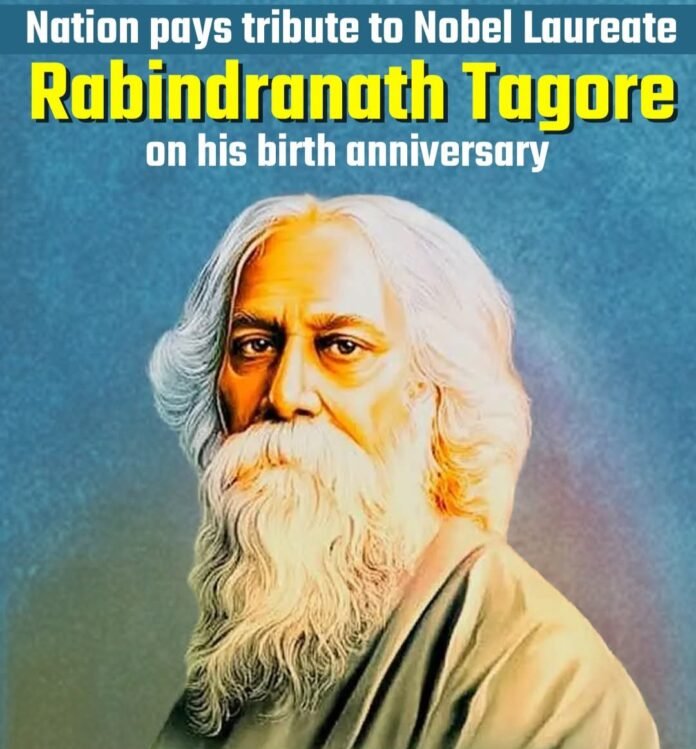
Every year on May 7, India remembers one of its greatest literary and cultural icons — Rabindranath Tagore. Revered as Gurudev, Tagore was not just a poet, but a philosopher, educationist, musician, painter, and nationalist thinker whose influence continues to shape Indian culture and global literature even today. His birth anniversary, popularly celebrated as Rabindra Jayanti, is observed with great respect across India, especially in Kolkata and the state of West Bengal.
Born on May 7, 1861, into the illustrious Tagore family of Jorasanko in Calcutta, Rabindranath Tagore displayed extraordinary literary talent from a very young age. He began writing poetry as a child and went on to transform Bengali literature with his unique style and deep philosophical insight. Over his lifetime, he authored thousands of poems and songs, along with novels, essays, short stories, and plays. His timeless works such as Gitanjali, Gora, Kabuliwala, and Ghare Baire remain literary treasures.
Tagore achieved global recognition in 1913 when he became the first non-European to win the Nobel Prize in Literature for Gitanjali (Song Offerings). This historic achievement placed Indian literature on the world map and made him a symbol of India’s intellectual and artistic brilliance.
One of Tagore’s most remarkable contributions was in music and nationalism. He composed over 2,000 songs, collectively known as Rabindra Sangeet, which continue to be deeply cherished in Bengali culture. Remarkably, he also penned the national anthems of two countries — India’s Jana Gana Mana and Bangladesh’s Amar Shonar Bangla.
Beyond literature and music, Tagore was a visionary educator. He founded Visva-Bharati University at Santiniketan with the belief that education should nurture creativity, freedom of thought, and harmony with nature. His educational philosophy was far ahead of its time and continues to inspire modern learning systems.
Rabindranath Tagore’s birth anniversary is celebrated through cultural programs, poetry recitations, musical performances, seminars, and tributes across schools, universities, and cultural institutions. Artists perform Rabindra Sangeet, while readers revisit his poetry and essays that speak of humanity, freedom, nature, and universal brotherhood.
Even decades after his passing in 1941, Tagore’s words continue to inspire millions around the world. His famous prayer, “Where the mind is without fear and the head is held high,” remains a timeless vision of an enlightened and progressive society. On his birth anniversary, India not only celebrates a literary genius but also remembers a thinker whose ideas transcended borders and generations.