

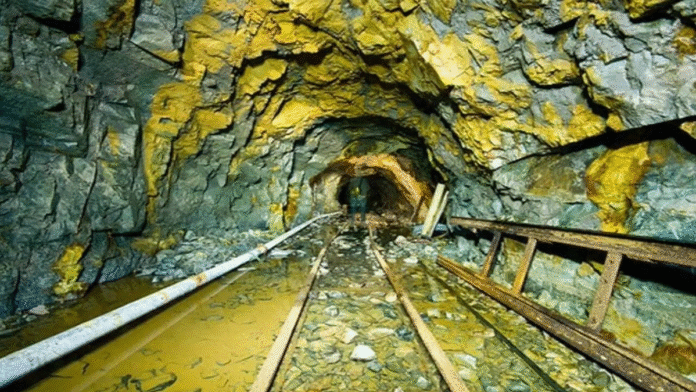
India is set to witness a major milestone in its mining sector with the launch of the Jonnagiri Gold Project in Kurnool district. Touted as the country’s first large-scale private gold mine since Independence, the project marks a significant step toward reducing India’s dependence on gold imports and advancing the vision of Aatmanirbhar Bharat in the mineral sector.
India’s Heavy Dependence on Gold Imports
India imports over 800 tonnes of gold annually, placing sustained pressure on foreign exchange reserves. Domestic production has remained limited for decades.
Currently, Hutti Gold Mines is the only major operational gold producer in the country, with an annual output of around 1.5 tonnes. The closure of Kolar Gold Fields in 2000 created a major gap in large-scale gold mining, making India heavily reliant on international markets.
Jonnagiri Gold Project: Scale and Investment
The Jonnagiri gold mine spans approximately 598 hectares, covering the villages of Jonnagiri, Erragudi, and Pagidirayi in Kurnool district.
The project is being developed by Geomysore Services India Pvt Ltd, backed by Thriveni Earthmovers & Infra and Deccan Gold Mines Ltd. An investment of over ₹400 crore has already been made.
Andhra Pradesh Chief Minister N. Chandrababu Naidu is expected to dedicate the project to the nation in early May 2026.
Production Capacity and Economic Impact
The processing plant has been completed in just 13 months and is currently in the final stage of pre-commercial operations.
- Certified gold resources: 13.1 tonnes
- Estimated potential reserves: up to 42.5 tonnes
- Annual production capacity: ~1,000 kg of refined gold
- Operational lifespan: ~15 years
Experts believe the Jonnagiri project could act as a catalyst for private sector participation in gold and critical mineral exploration across India, boosting economic growth and reducing import dependency.
How Gold Is Extracted: From Rock to Doré Bars
The gold extraction process at Jonnagiri follows modern mining and metallurgical techniques:
- Open-Pit Mining: Drilling and controlled blasting break hard rock formations.
- Crushing & Grinding: Ore is crushed into fine particles.
- Gravity Separation: Coarse gold is recovered.
- Carbon-in-Leach Process: Cyanide solution dissolves remaining gold.
- Absorption & Recovery: Gold binds to activated carbon, followed by elution and electro-winning.
- Smelting: Final purification produces doré gold bars.
This process ensures efficient recovery of gold from low-grade ore, making large-scale mining commercially viable.
Key Facts
- Jonnagiri is India’s first large-scale private gold mine since Independence.
- Hutti Gold Mines remains India’s only major active gold producer.
- Kolar Gold Fields, once India’s most famous gold mine, closed in 2000.
- Gold mining helps reduce import dependence and conserve foreign exchange.
Why Jonnagiri Matters for India
The Jonnagiri Gold Project is more than just a mining venture—it represents a strategic shift in India’s resource policy. By boosting domestic production, India can:
- Reduce reliance on imported gold
- Strengthen economic resilience
- Promote private investment in mining
- Support the Aatmanirbhar Bharat initiative
As the project begins operations, it is expected to redefine India’s gold mining landscape and open new avenues for exploration and industrial growth.