

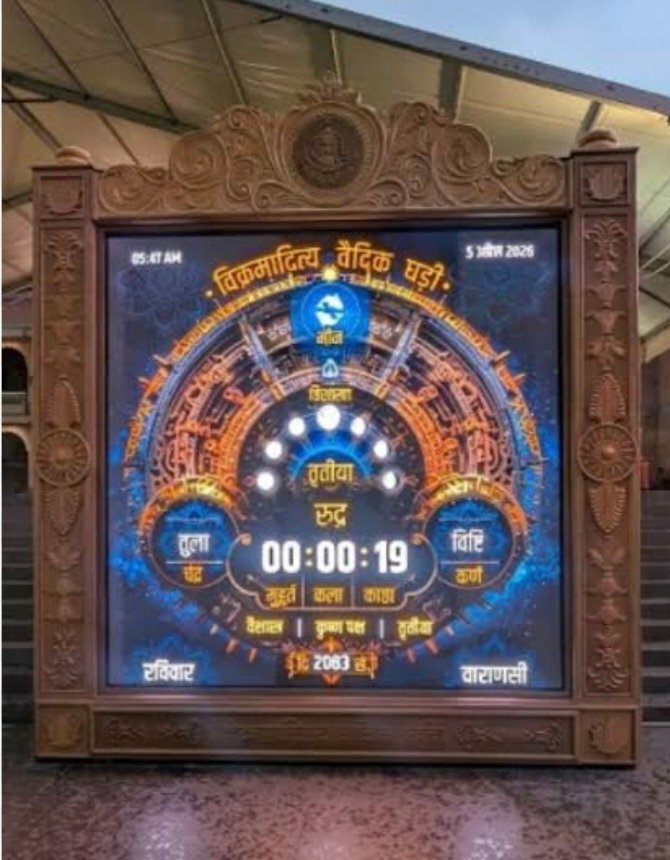
In a unique blend of tradition and innovation, the Vikramaditya Vedic Clock has been installed at the Kashi Vishwanath Temple, offering devotees a remarkable glimpse into India’s ancient system of timekeeping. Unveiled in early April 2026, the clock is being hailed as the world’s first device to display time based on the traditional Vedic Panchang rather than the modern 24-hour Gregorian system.
Weighing around 700 kilograms, the clock was gifted by Madhya Pradesh Chief Minister Mohan Yadav and installed in the presence of Uttar Pradesh Chief Minister Yogi Adityanath. Its installation marks a cultural milestone aimed at reviving India’s ancient “kaal ganana” (time-reckoning) traditions while integrating them with contemporary digital technology.
What sets the Vikramaditya Vedic Clock apart is its fundamentally different concept of time. Unlike conventional clocks that begin the day at midnight, this system starts at sunrise and divides the day into 30 muhurtas, each lasting approximately 48 minutes. Sunset typically occurs around the 15th muhurta, reflecting the natural rhythm of the solar cycle.
Beyond simply telling time, the clock serves as a comprehensive astronomical and cultural instrument. It displays key elements of the Hindu calendar such as tithi (lunar day), nakshatra (constellation), planetary positions, moon phases, eclipses, and other Panchang details. At the same time, it also shows Indian Standard Time (IST) and Greenwich Mean Time (GMT), making it both traditional and globally relevant.
An important feature of the clock is its use of Local Mean Time (LMT), which is calculated based on the position of the sun at a specific location. This makes it more precise for local conditions compared to standardized time systems. According to experts involved in the project, Vedic time calculations may even offer improved accuracy in certain predictive and astronomical contexts.
Developed with inputs from institutions like the Maharaja Vikramaditya Research Centre in Ujjain, the clock is not just a technological innovation but also a cultural revival. It transforms the temple परिसर into a living showcase of India’s scientific heritage, allowing visitors to experience time as it was understood in ancient India.
The installation has quickly become a major attraction for pilgrims and tourists alike. More importantly, it reflects a broader effort to reconnect modern society with traditional knowledge systems—demonstrating how ancient science and contemporary technology can coexist and enrich one another.
The Vikramaditya Vedic Clock thus stands as a symbol of India’s timeless legacy—where spirituality, astronomy, and innovation come together in harmony.