

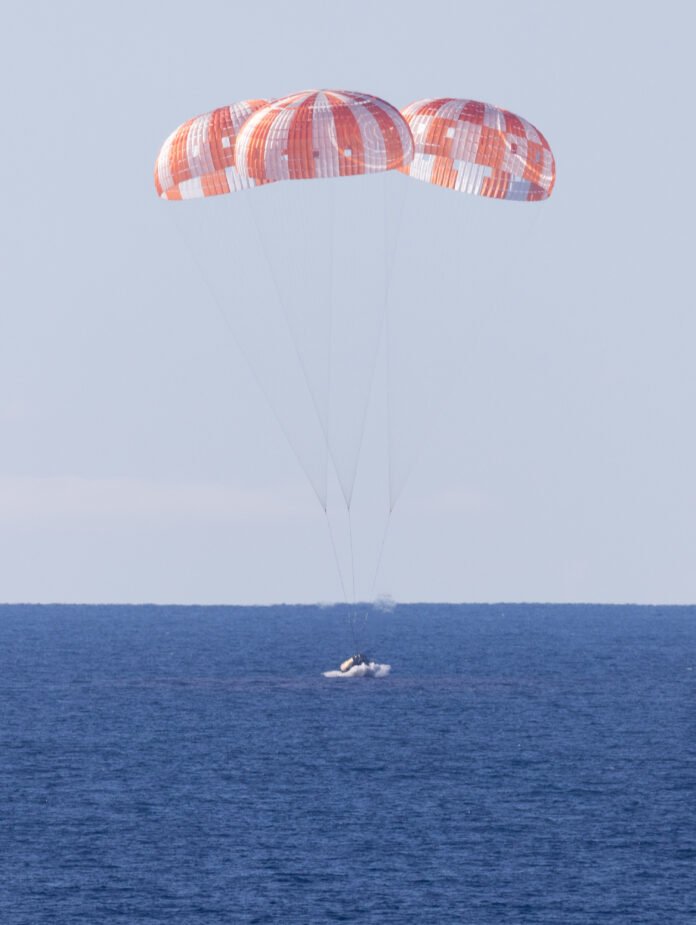
In a landmark achievement for human spaceflight, NASA’s Artemis II mission concluded successfully with a safe splashdown in the Pacific Ocean on April 10, 2026, bringing back four astronauts after a groundbreaking journey around the Moon. The mission marks humanity’s first crewed lunar flyby in more than 50 years since the Apollo era and represents a major step toward returning humans to the lunar surface.
The crew—Reid Wiseman, Victor Glover, Christina Koch, and Jeremy Hansen—spent approximately 10 days aboard the Orion spacecraft, traveling nearly 700,000 miles during their mission. Notably, they set a new record for the farthest distance humans have ever traveled from Earth, surpassing the benchmark set by Apollo 13 in 1970.
Launched in early April 2026, Artemis II was designed as a critical test flight to evaluate deep-space systems, including life-support, navigation, and communication technologies, ahead of future crewed Moon landings. The spacecraft looped around the Moon without landing, allowing astronauts to observe the lunar surface and conduct scientific observations while testing mission operations in deep space.
The return journey was one of the most challenging phases. Orion re-entered Earth’s atmosphere at speeds approaching 25,000 miles per hour, enduring extreme temperatures of up to 4,000–5,000°F. A brief communications blackout occurred during re-entry due to ionized plasma surrounding the capsule. However, the spacecraft performed flawlessly, deploying parachutes before making a precise splashdown off the coast of California, where recovery teams quickly retrieved the crew.
Beyond its technical success, Artemis II also carried historic significance in terms of representation. Christina Koch became the first woman to travel to the Moon, Victor Glover the first Black astronaut on such a mission, and Jeremy Hansen the first non-American to journey around the Moon.
The mission’s success paves the way for future Artemis missions, including planned lunar landings later this decade. It also reinforces NASA’s long-term vision of establishing a sustained human presence on the Moon and eventually sending astronauts to Mars.
Artemis II stands as a defining moment in modern space exploration—reviving humanity’s lunar ambitions while laying the groundwork for deeper journeys into the cosmos.