

A Transformative Step Towards Future-Ready Learning
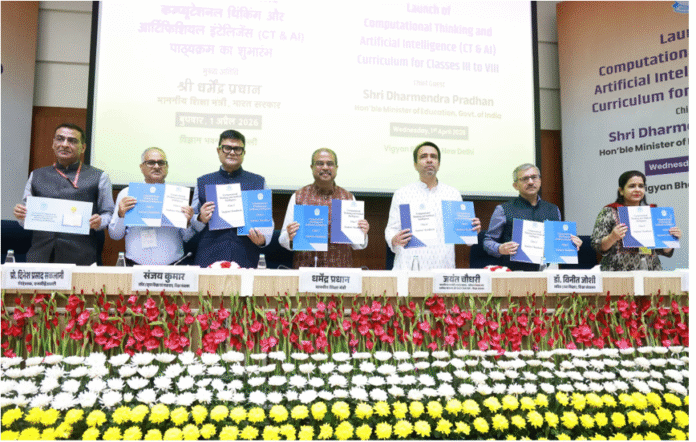
India has taken a decisive leap towards modernising its education system with the launch of a new Computational Thinking (CT) and Artificial Intelligence (AI) curriculum by the Central Board of Secondary Education. Introduced by Dharmendra Pradhan at Vigyan Bhawan, this initiative is being hailed as a “transformative step towards future-ready learning”, aligned with the vision of the National Education Policy 2020.
The curriculum will be implemented for students from Classes III to VIII starting the 2026–27 academic session, marking the first time that structured AI education is being introduced at such an early stage across the school system.
What the New Curriculum Offers
At its core, the programme is designed to create “AI-ready learners” by building strong foundations in computational thinking. Students will be introduced to essential cognitive skills such as logical reasoning, problem-solving, and pattern recognition, while also learning how artificial intelligence operates in everyday life.
The curriculum goes beyond technical knowledge. It aims to nurture digital literacy, critical thinking, innovation, and ethical decision-making, ensuring that students not only use technology but understand and shape it responsibly.
To support this, the initiative is backed by structured modules, detailed teacher handbooks, and robust assessment frameworks, ensuring systematic and early exposure to emerging technologies.
A Shift in How Students Learn
One of the most significant aspects of this reform is its change in teaching methodology. The curriculum adopts a playful and experiential approach, replacing rote memorisation with hands-on learning.
Students will engage in puzzles, games, worksheets, and collaborative problem-solving activities. Teachers will guide them to break down complex problems into smaller parts and interpret visual data like charts and patterns.
Assessment methods will also evolve. Instead of focusing solely on exams, the system will move towards continuous and competency-based evaluation, tracking a student’s ability to think creatively and apply knowledge in real-world contexts.
The Vision Behind the Reform
The initiative is guided by the philosophy of “AI for Education, AI in Education”, reflecting a dual approach—using AI as a tool for learning while also teaching it as a subject.
As highlighted by Dharmendra Pradhan, this reform is not merely academic but a national investment in human capability, aimed at preparing students for a rapidly evolving, technology-driven world.
The broader goal is to ensure that students are not passive consumers of technology, but innovators, creators, and responsible digital citizens.
The Way Ahead
The introduction of AI education at the foundational level signals a major shift in India’s learning landscape. It reflects a move away from traditional, exam-centric education towards a system that prioritises skills, adaptability, and future readiness.
However, the success of this ambitious initiative will depend on effective implementation—especially in areas like teacher training, infrastructure, and ensuring equal access across schools.
If executed well, this curriculum could redefine Indian classrooms, transforming them into spaces where students don’t just learn facts—but learn how to think, create, and lead in the age of artificial intelligence.