

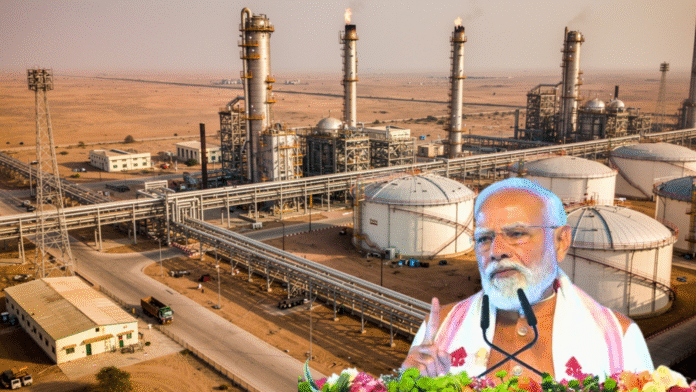
In a landmark moment for India’s energy and industrial future, Prime Minister Narendra Modi is set to inaugurate the ambitious Pachpadra Refinery project in Rajasthan’s Barmer (Balotra) district on April 21, 2026. This long-awaited mega project is being seen as a transformative milestone not just for Rajasthan, but for India’s broader economic and energy landscape.
What is the Pachpadra Refinery Project?
The Pachpadra Refinery, also known as the Barmer Refinery, is a greenfield refinery-cum-petrochemical complex developed by HPCL Rajasthan Refinery Limited—a joint venture between Hindustan Petroleum Corporation Limited (74%) and the Government of Rajasthan (26%).
With a refining capacity of 9 million metric tonnes per annum (MMTPA), including 2.4 MMTPA of petrochemical output, the project places Rajasthan firmly on India’s industrial and energy map.
Spread across thousands of acres in western Rajasthan, the refinery is designed as a modern integrated facility capable of producing a wide range of petroleum and petrochemical products, supporting downstream industries.
Project Cost and Scale
Originally conceived at around ₹43,000 crore, the project has undergone significant expansion and cost escalation over the years. It is now estimated at approximately ₹80,000 crore, making it one of the largest refinery investments in India.
This scale reflects both its complexity and its importance as a mega infrastructure project aimed at long-term industrial growth.
Economic Lifeline for Rajasthan
The refinery is widely described as an “economic lifeline” for the region. It is expected to:
●Generate massive employment opportunities, both direct and indirect
●Boost industrialisation in the Marwar region
●Attract petrochemical and manufacturing industries in nearby zones
●Strengthen Rajasthan’s position as an emerging energy hub
Additionally, the development of a petrochemical zone around the refinery is already attracting investments in sectors like plastics, chemicals, textiles, and pharmaceuticals, creating a ripple effect of economic activity.
Strategic Importance for India
In the present global scenario—marked by volatile crude oil prices, geopolitical tensions, and energy security concerns—projects like the Pachpadra Refinery are critically important.
1. Strengthening Energy Security
India is one of the world’s largest importers of crude oil. Increasing domestic refining capacity helps reduce dependence on external processing and enhances self-reliance in fuel production.
2. Boosting Petrochemical Growth
The inclusion of petrochemical units ensures that India moves beyond fuel production into high-value chemical manufacturing, which is essential for industries ranging from packaging to pharmaceuticals.
3. Regional Industrial Balance
Traditionally, most refineries have been concentrated in coastal regions. This project helps balance industrial growth by bringing large-scale energy infrastructure to inland India, particularly western Rajasthan.
4. Integration with National Infrastructure
The refinery is strategically linked to major infrastructure corridors like the Amritsar–Jamnagar Expressway, enhancing logistics and connectivity for crude supply and product distribution.
A Transformational Milestone
The inauguration of the Pachpadra Refinery marks more than just the completion of a project—it signals a shift in India’s industrial ambitions. From a desert region historically seen as remote, Barmer is poised to emerge as a major petro-industrial hub.
As India continues to position itself as a global economic powerhouse, projects like this underline a clear vision: energy security, industrial expansion, and regional development working together.
On April 21, as the refinery is formally dedicated to the nation, it will stand as a symbol of how infrastructure can redefine the destiny of a region—and contribute to the strength of an entire nation.