

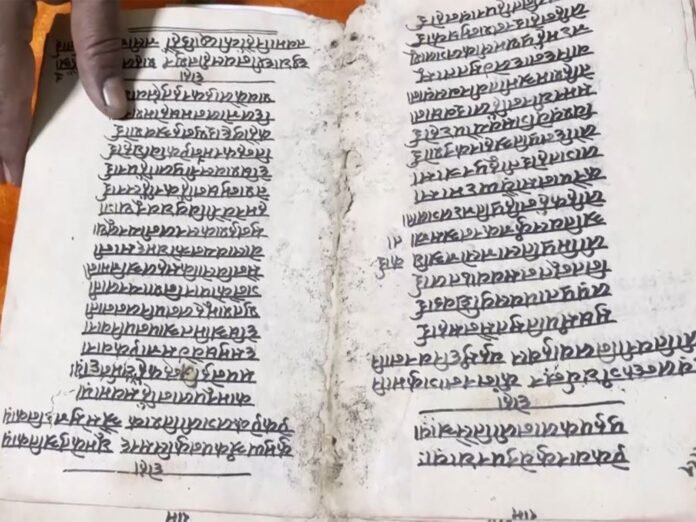
In a discovery that beautifully intertwines history, language, and faith, a rare manuscript linked to the Ramayana tradition has been found in Ayodhya. Estimated to be around 150–200 years old, the manuscript offers a valuable window into India’s literary past and the evolution of its writing systems.
What Has Been Found?
The manuscript contains portions from the Ramayana tradition—most likely associated with the widely revered Ramcharitramanas, composed by Tulsidas. This version of the epic has historically been the most popular in North India, making it a probable source of the text.
What makes this discovery particularly significant is the script. The manuscript is written in an early form of the Devanagari Script, showing noticeable differences from its modern standardized form. Experts suggest that the letter formations and vowel markings reflect a transitional phase in script development, offering clues about how written language evolved during the 19th century.
The manuscript is being transferred to the International Ram Katha Museum, where it will undergo preservation, study, and possibly be displayed for the public.
Why Is This Discovery Important?
This find holds significance across multiple domains:
●Linguistic Insight: It provides rare material for scholars to study the evolution of Devanagari from earlier Nagari forms.
●Cultural Heritage: Ayodhya’s historical and spiritual importance is further enriched by such discoveries.
●Religious Continuity: Manuscripts like these reveal how sacred texts were copied, preserved, and passed down through generations.
●Historical Record: As primary sources, manuscripts help historians reconstruct the literary and social fabric of their time.
What Are Manuscripts?
Manuscripts are handwritten documents created before the widespread use of printing technology. The term originates from the Latin manu scriptus, meaning “written by hand.”
In India, manuscripts were traditionally written on materials such as palm leaves, birch bark, or handmade paper. They have preserved centuries of knowledge—ranging from epics and scriptures to science, medicine, and poetry. Each manuscript is unique, often reflecting regional styles, linguistic variations, and the individuality of the scribe.
Understanding the Devanagari Script
The Devanagari Script is one of India’s most widely used writing systems today, employed for languages such as Hindi, Sanskrit, and Marathi.
It is an abugida, where each consonant carries an inherent vowel sound that can be modified using diacritical marks. Its origins can be traced back to ancient Brahmi script, evolving through Gupta and Nagari forms before reaching its present-day structure. Studying older forms, like the one seen in this manuscript, helps scholars map this long and fascinating journey of script evolution.
A Living Link to India’s Past
Discoveries like this are far more than historical curiosities—they are living bridges to India’s intellectual and spiritual heritage. This manuscript from Ayodhya not only deepens our understanding of script development but also reaffirms the enduring legacy of the Ramayana tradition in shaping Indian culture.
As it is carefully preserved and studied, it promises to reveal even more about a time when knowledge was painstakingly written by hand—ensuring that stories of faith, morality, and devotion would endure across generations.