

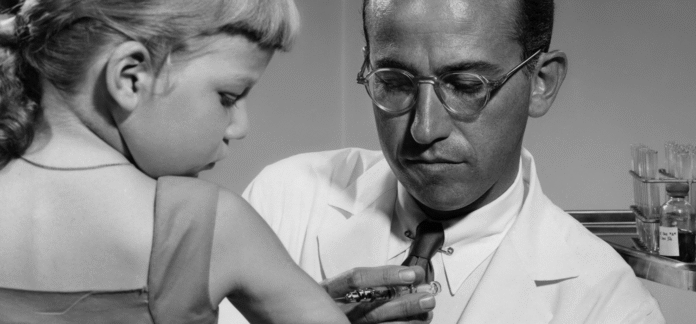
In a time when fear traveled faster than hope, there was a disease that stole childhoods. It came quietly. One day, a boy would be running across a field, laughing, chasing a ball under the summer sun. The next day, he would lie still—his small body trapped inside a cold metal shell, an iron lung breathing for him. Mothers stopped letting their children play outside. Fathers carried a silent dread. Summer was no longer a season of joy—it was a season of waiting.
The disease was Poliomyelitis. And the world had no cure. No protection. No answers.
Hospitals were filled with the sound of machines and muffled cries. Nurses washed their hands until their skin cracked and bled, because that was all they could do. There were no vaccines to buy, no medicines to trust—only fear to endure.
Then, in a quiet laboratory in Pittsburgh, a man chose a different path. His name was Jonas Salk.
He wasn’t the only one searching for answers. Many brilliant minds were working carefully, slowly, methodically. But Salk believed something different that sometimes, when the world is suffering, you cannot afford to wait. He worked relentlessly. Days blurred into nights. Failures came often.
But to him, failure wasn’t the end. “Blind alleys are always opportunities,” he would later say.
Every mistake was a clue. Every dead end, a new direction. While others hesitated, he moved forward—with courage, with urgency, and with an unshakable belief that children deserved a future free from fear. In a bold act of faith, he tested the vaccine not just on volunteers—but on himself, his wife, and his children. In his own home, with boiled syringes and trembling hope, he chose trust over doubt.
And then, the moment came. On April 12, 1955, the world held its breath. The announcement spread like sunlight after a long storm—the vaccine was safe. It worked. Church bells rang. Strangers embraced. Grown men wept in the streets. For the first time in years, parents exhaled. Humanity had been given a second chance.
But the most extraordinary part of this story came next. In a world where such a discovery could have made him unimaginably wealthy, Salk was asked a simple question:
Who owns the patent? His answer was even simpler. “The people,” he said. Then he added something the world would never forget: “Could you patent the sun?” He refused to profit.
There were no price tags on hope. No ownership over life-saving science. At a time when vaccines were not sold, but given, he chose humanity over wealth. Because to him, this was never about recognition. It was about relief—the quiet, priceless relief of a world no longer afraid.
Cases of polio fell dramatically. Within years, a disease that once haunted millions began to disappear. And Salk? He did not chase fame. He built a place for future dreamers—a sanctuary for science, where curiosity and compassion could grow together. His legacy was not just a vaccine.
It was a reminder. That the greatest breakthroughs are not always born from perfect paths—but from courage in uncertainty. That blind alleys are not the end. And that sometimes, the most powerful thing a human being can say is: This belongs to everyone.