

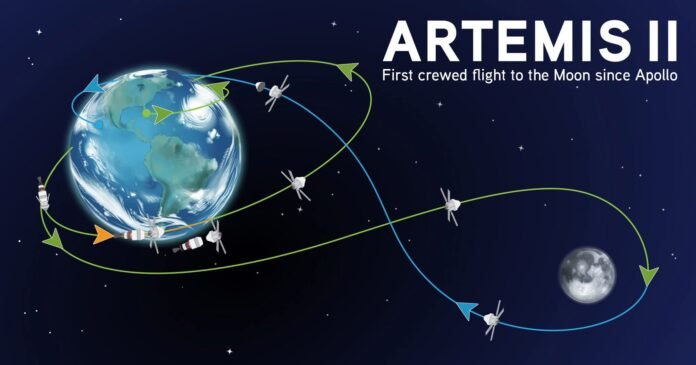
NASA’s Artemis II has entered a landmark phase, marking humanity’s first crewed journey beyond Earth’s orbit since the Apollo Program. Launched on April 1, 2026, aboard the Orion spacecraft, the four-member crew is currently travelling toward the Moon on a carefully planned free-return trajectory—ensuring a safe loop around the Moon before heading back to Earth.
Where has Artemis II reached?
Following a successful launch and initial Earth-orbit tests, Orion executed a critical translunar injection burn, propelling it into deep space at speeds exceeding 35,000 km/h. The spacecraft is now more than halfway to the Moon, steadily advancing toward its upcoming lunar flyby.
During this journey, Artemis II is expected to travel roughly 4,000 miles beyond the Moon before beginning its return path—pushing the boundaries of human spaceflight farther than ever since the Apollo era.
Breathtaking images of Earth
One of the most captivating highlights of the mission so far has been the stunning images of Earth shared by NASA. Captured from tens of thousands of miles away, these visuals show our planet as a radiant blue sphere suspended in the vast darkness of space.
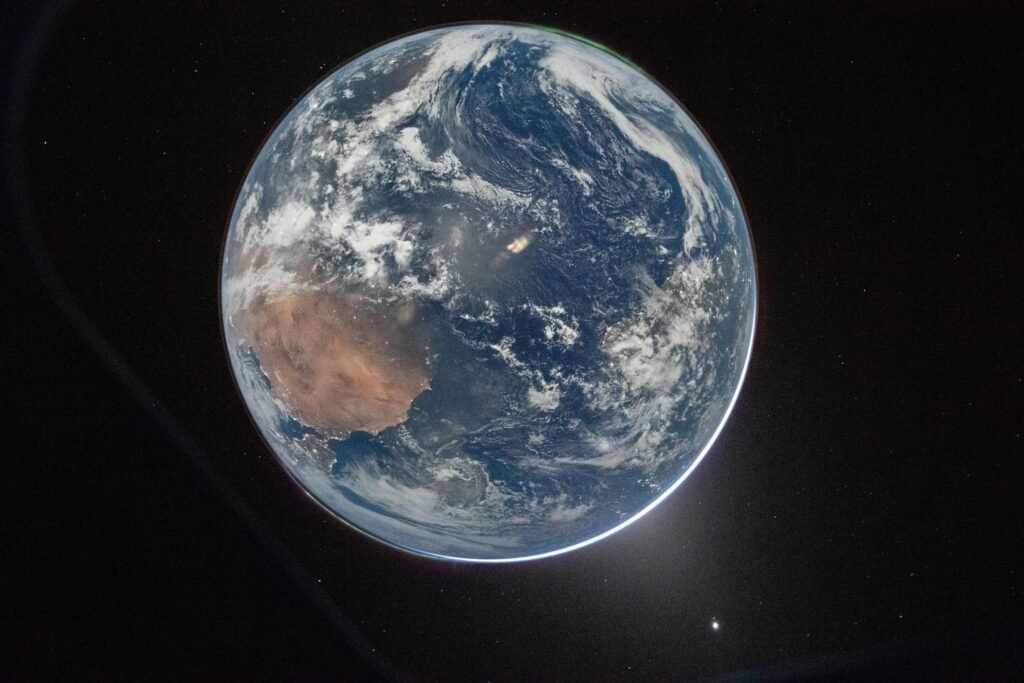
The images reveal intricate details—swirling cloud systems, the glowing edge of the atmosphere, and even the faint shimmer of auroras. Echoing the iconic “Earthrise” moment from Apollo 8, these photographs offer a humbling reminder of Earth’s fragility and beauty, reigniting global fascination with space exploration.
Mission significance
Artemis II is a crucial step in NASA’s long-term vision to return humans to the Moon and eventually reach Mars. The mission is also historic for its diverse crew, reflecting a new era of inclusivity in space exploration.
Beyond its symbolic importance, the mission is testing vital systems—from life support to navigation—that will be essential for future missions, especially Artemis III , which aims to land astronauts on the lunar surface later this decade.
What lies ahead?
In the coming days, the spacecraft will perform its close lunar flyby before beginning the journey back to Earth, completing a mission of around 10 days. So far, the mission has proceeded smoothly, with only minor and manageable technical issues reported.
As Artemis II continues its voyage, it not only advances scientific and technological frontiers but also rekindles a timeless human spirit—the desire to explore the unknown, while reminding us of the singular beauty of our home planet.