

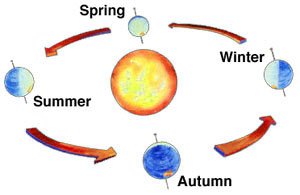
Not Distance, But Tilt: The Real Reason for Seasons
Every year, as winter melts into spring and summer gives way to autumn, nature undergoes a visible transformation. A common misconception is that seasons are caused by the Earth moving closer to or farther from the Sun. In reality, the primary reason lies in the Earth’s tilt and its journey through space.
The Role of Earth’s Tilt
The Earth is tilted at an angle of about 23.5 degrees on its axis—an idea explained by the Axial tilt. As the planet revolves around the Sun, this tilt causes different regions to receive varying amounts of sunlight throughout the year.
When the Northern Hemisphere tilts toward the Sun, it experiences summer, with longer days and warmer temperatures. At the same time, the Southern Hemisphere faces winter. Six months later, the situation reverses, bringing seasonal balance to the planet.
Sunlight Angle and Intensity
Another key factor is how directly sunlight hits the Earth. During summer, sunlight strikes more directly, concentrating energy and increasing temperatures. In winter, sunlight arrives at a slanted angle, spreading over a larger area and becoming less intense. This process is described by the concept of Solar Insolation.
Solstices and Equinoxes: Marking Seasonal Shifts
Seasonal changes are also marked by important astronomical events. The Summer Solstice is the longest day of the year, while the Winter Solstice is the shortest. In contrast, equinoxes occur when day and night are nearly equal across the globe.
A Perfect Cosmic Balance
In essence, seasons are the result of a delicate interplay between Earth’s tilt, its orbit, and the distribution of sunlight. This natural rhythm not only shapes weather patterns but also influences ecosystems, agriculture, and daily human life—highlighting our deep connection with the cosmos.