

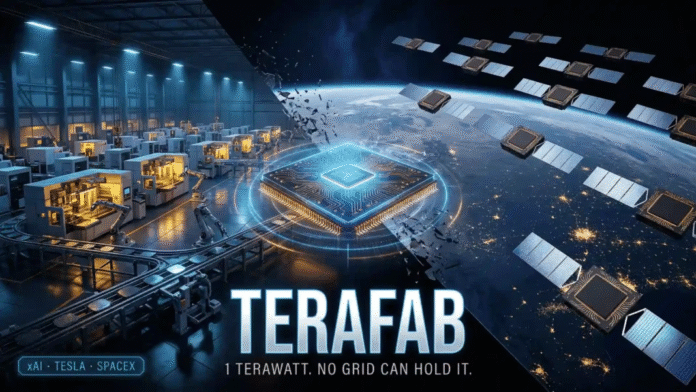
Elon Musk has announced an ambitious semiconductor initiative named “Terafab” in Austin, aimed at scaling up artificial intelligence chip production. The project—linked to Tesla, SpaceX, and xAI—seeks to address the growing demand for advanced chips required for autonomous driving, robotics, and AI systems.
What is the Terafab Project?
Terafab is envisioned as a massive semiconductor fabrication facility, significantly larger than Tesla’s existing gigafactories. It will function as an advanced technology hub capable of designing, manufacturing, and testing next-generation chips. The project reflects concerns that current global chip production capacity may not keep pace with the rapidly increasing demand for AI-driven applications.
Focus on AI5 Chip Development
The facility will primarily produce Tesla’s fifth-generation AI chip, known as AI5. This chip is expected to power Full Self-Driving (FSD) systems and future robotics platforms. The AI5 chip represents Tesla’s push toward greater vertical integration, reducing reliance on external semiconductor suppliers.
Need for In-House Chip Manufacturing
Musk has emphasized that existing suppliers such as Samsung Electronics, TSMC, and Micron Technology may not be able to meet Tesla’s projected chip requirements. Terafab is thus aimed at ensuring a stable and scalable supply of semiconductors. The initiative aligns with a broader industry trend where major tech companies are investing in in-house chip capabilities.
Important Facts
- Terafab is a proposed large-scale semiconductor fabrication facility in Texas.
- It focuses on AI chip production, especially Tesla’s AI5 chip.
- Semiconductor fabs require high investment and long gestation periods.
- AI chips are critical for autonomous vehicles and robotics.
Challenges and Future Vision
Building semiconductor fabrication plants involves extremely high capital costs—often running into tens of billions of dollars—and requires several years to become operational. Elon Musk has also hinted at future technological ambitions, including space-based AI computing through satellite networks. Despite uncertainties in timelines, Terafab represents a strategic step toward meeting future AI and computing demands at scale.