

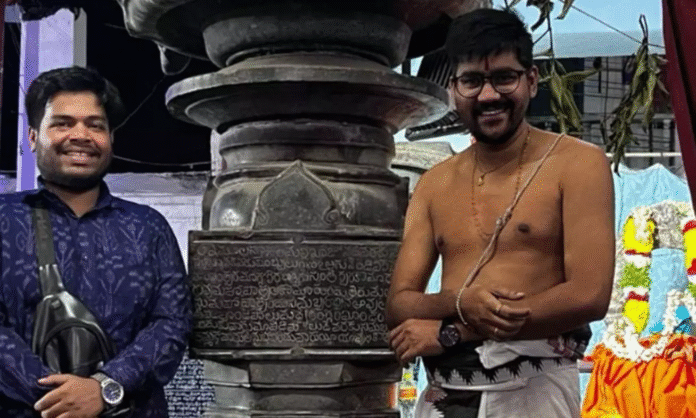
A fascinating slice of medieval history has come to light in Guntur, where a newly noticed Telugu inscription tied to the powerful Gajapathi rulers of Odisha has been found on a stone pillar at the historic Lakshmi Narasimha Swamy Temple in Ramachandrapura Agraharam. The discovery sheds fresh light on the deep political, religious, and cultural ties that once linked coastal Andhra with the Odisha region during the late medieval era. Historians say such inscriptions act like time capsules, revealing how the Gajapathi empire administered distant regions while also supporting temple traditions.
A message from the time of King Purushottama Deva
Epigraphist Bishnu Mohan Adhikari reports that the inscription is carved on both sides of a stone pillar in the temple mandapa. The text mentions Kumaraguru Mahapatra, a steward serving under Gajapathi King Purushottama Deva, one of the most influential rulers of the 15th century.
This reference is significant because it confirms that the administrative network of the Gajapathi kingdom extended into parts of present-day Andhra Pradesh, demonstrating the reach and influence of the dynasty beyond Odisha.
Temple pillars with a journey through history
Local tradition adds an intriguing story to the discovery. According to temple accounts, the idol of Lord Narasimha at the Guntur temple was originally brought from Kondaveedu Fort during turbulent medieval invasions.
Temple priest Nadyala Yoganand explains that the stone pillars of the mandapa were also transported from Kondaveedu—reportedly after a divine instruction received in a dream. Interestingly, the Narasimha temple at Kondaveedu itself houses an Odia inscription from the Gajapathi rulers documenting donations made for ritual worship, suggesting a strong historical link between the two sites.
Insights into temple rituals and pastoral communities
The inscription originally belonged to a shrine dedicated to Lord Mulasthana Mallikarjuna of Kondaveedu before the structure was relocated. It contains detailed instructions for temple worship—stating that milk should be offered to the deity during evening rituals.
It also mentions that cows meant for ritual offerings must remain under the care of certain communities, such as Tammula and Ambicvaru, who may have been pastoral groups like the Koyas.
Notably, the name Kumaraguru Mahapatra appears in other inscriptions from the wider Kalinga region, including areas of today’s Ganjam and Visakhapatnam, indicating his administrative role across the Gajapathi territories.
Cultural bridge between Odisha and Andhra
Scholars note that inscriptions from Kondaveedu and Guntur together reveal the Hari–Hara tradition of worship, which blends devotion to Shiva and Vishnu. The Gajapathi rulers are known to have supported both Shaiva and Vaishnava traditions in temples across their domains.
For historians, discoveries like this are invaluable. They not only map the political reach of medieval kingdoms but also illuminate how religious practices, cultural ideas, and administrative systems connected Odisha and coastal Andhra centuries ago.