

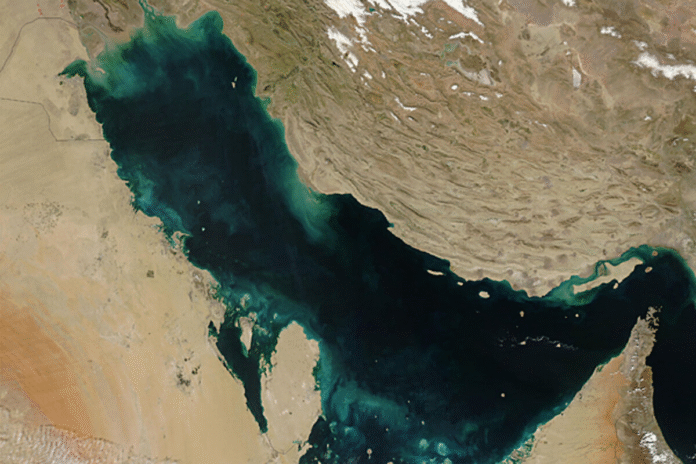
The Persian Gulf is one of the most strategically important water bodies in the world. Located in the Middle East, it is a shallow sea that lies between Iran and the Arabian Peninsula. The gulf plays a crucial role in global energy supply, international trade, and geopolitics, making it a key region for the world economy.
What is the Persian Gulf?
The Persian Gulf is a marginal sea of the Indian Ocean. It stretches for about 990 kilometres (615 miles) and covers an area of roughly 241,000 square kilometres. The gulf connects to the open ocean through the Strait of Hormuz, which leads to the Gulf of Oman and eventually the Arabian Sea.
The region surrounding the Persian Gulf includes several oil-rich nations and has been a centre of trade and cultural exchange for centuries.
Countries bordering the Persian Gulf
Eight countries share coastlines along the Persian Gulf:
- Iran
- Iraq
- Kuwait
- Saudi Arabia
- Bahrain
- Qatar
- United Arab Emirates
- Oman
Because of its location between Asia, Africa, and Europe, the Persian Gulf has historically been a major maritime trade route.
Why is the Persian Gulf Important?
1. Global Oil and Gas Hub
The Persian Gulf region contains some of the largest oil and natural gas reserves in the world. Countries like Saudi Arabia, Iran, and Qatar export massive quantities of energy resources. A large share of the world’s oil supply passes through the gulf every day.
2. Strategic Shipping Route
The Strait of Hormuz, located at the entrance of the Persian Gulf, is one of the most important oil chokepoints in the world. Millions of barrels of crude oil and petroleum products move through this narrow waterway daily, connecting Gulf producers with global markets in Asia, Europe, and North America.
3. Economic Importance
Many Gulf countries depend heavily on oil exports and maritime trade. Major ports and offshore oil terminals in countries such as Kuwait, United Arab Emirates, and Bahrain handle a significant share of global energy shipments.
4. Geopolitical Significance
Due to its vast energy resources and strategic location, the Persian Gulf has been at the centre of several major conflicts, including the Iran–Iraq War, the Gulf War, and the Iraq War. Stability in the region is closely linked to global economic stability.
5. Historical and Cultural Importance
For centuries, the Persian Gulf served as a major trade route connecting the Middle East with India, Africa, and Europe. Historically, the region was known for industries such as fishing, pearl diving, and maritime trade before the discovery of oil in the early 20th century.
Key Geographic Facts About the Persian Gulf
- Length: About 990 km
- Maximum width: Around 340 km
- Average depth: Less than 90 metres
- Major rivers flowing into the gulf: Tigris River, Euphrates River, and Karun River
Conclusion
The Persian Gulf is one of the most strategically important regions in the world because of its energy resources, shipping routes, and geopolitical influence. As global demand for energy and trade continues to grow, the significance of the Persian Gulf in international economics and politics is likely to remain critical for decades to come.