

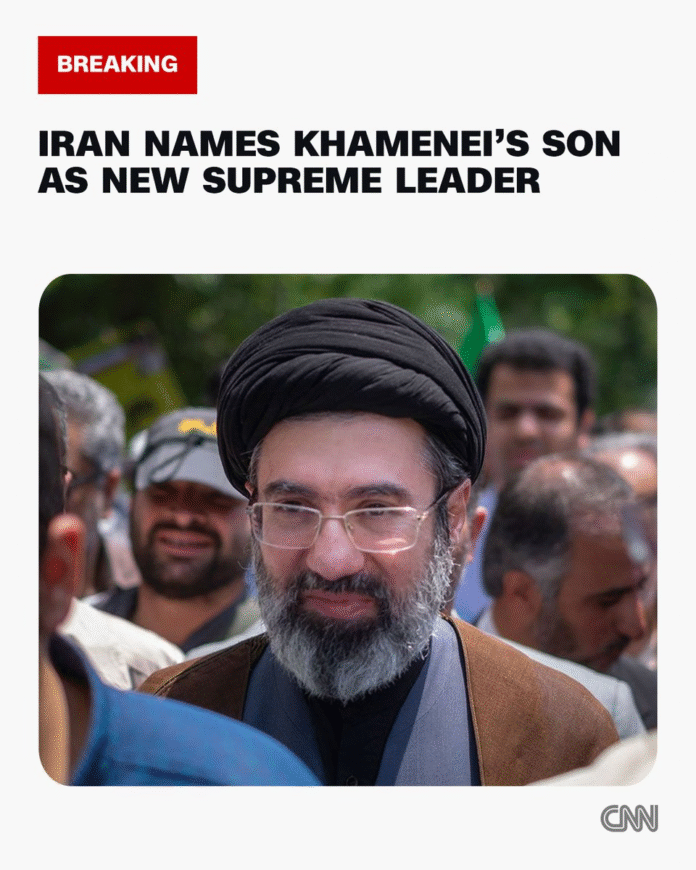
Mojtaba Khamenei, son of Iran’s late Supreme Leader Ali Khamenei, has been chosen as the country’s new Supreme Leader, according to an announcement broadcast on Iranian state television early Monday.
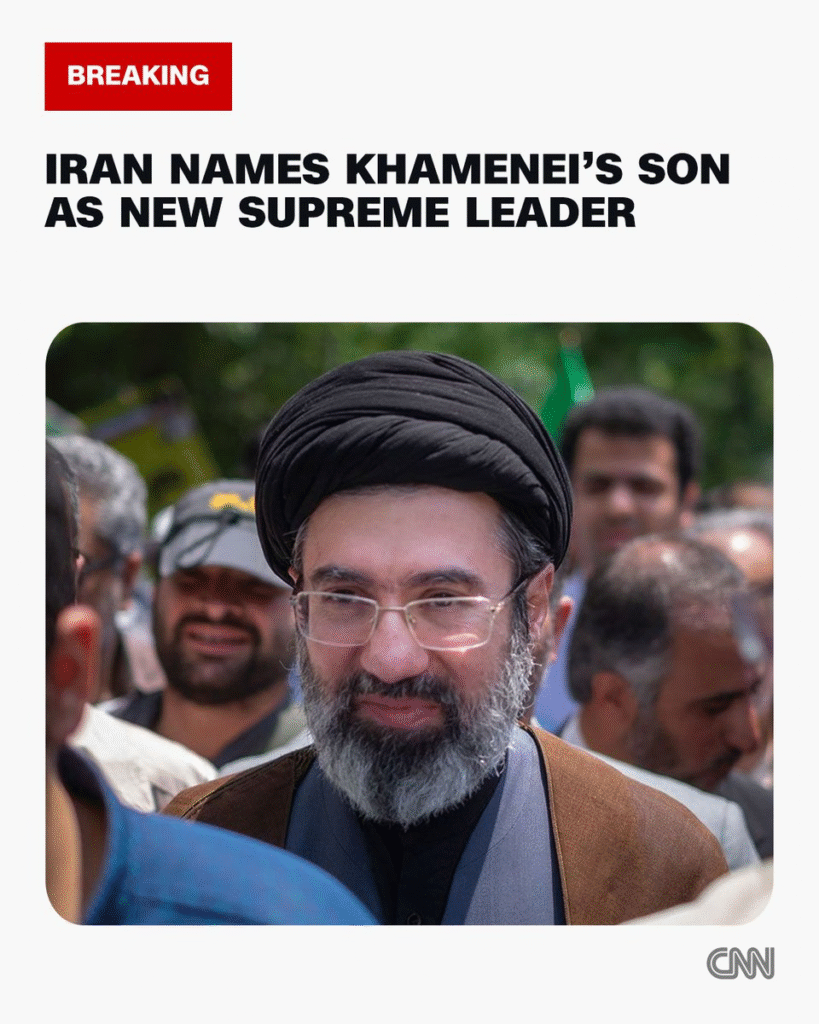
The development comes amid escalating tensions in the Middle East following the death of Ali Khamenei in an alleged U.S.–Israeli attack on February 28. His death has significantly intensified the ongoing regional conflict involving Iran, Israel, and the United States.
Mojtaba Khamenei had long been viewed as a strong contender to succeed his father, despite never holding any elected or formal government position. His selection marks a historic and controversial transition in Iran’s political and religious leadership.
Trump and Israel react
Following the announcement, Donald Trump, President of the United States, said that Iran should not appoint a new Supreme Leader without U.S. involvement. Meanwhile, Israel issued a warning that it would target Khamenei’s successor, further raising fears of escalation in the region.
Ali Khamenei’s 35-year rule
Ali Khamenei had held supreme authority in Iran for 35 years. He became the country’s Supreme Leader in 1989, following the death of Ruhollah Khomeini, the founder of the Islamic Republic.
Khamenei had earlier served as President of Iran from 1981 to 1989. He was a key figure in the Iranian Revolution of 1979, which led to the overthrow of Mohammad Reza Pahlavi, the Shah of Iran.
In Iran’s political system, the title “Ayatollah” refers to a high-ranking Shiite religious authority. Under Iran’s Islamic governance structure, the Supreme Leader is traditionally a senior religious scholar, and the title reflects significant religious authority.
Escalating conflict in the region
Meanwhile, the ongoing conflict between Iran, Israel and the United States has intensified:
- A building caught fire in Kuwait City after an alleged Iranian drone strike on Saturday night.
- Videos circulating online showed Israeli airstrikes in Tehran, the capital of Iran.
- Iran reportedly launched cluster bomb attacks on Israel late Saturday.
- Following Israeli strikes on oil storage facilities in Tehran, large quantities of oil spilled into the city’s drainage systems, creating river-like flows along nearby roads.
The developments signal a rapidly escalating geopolitical crisis in the Middle East, with analysts warning that the conflict could widen further in the coming days.