

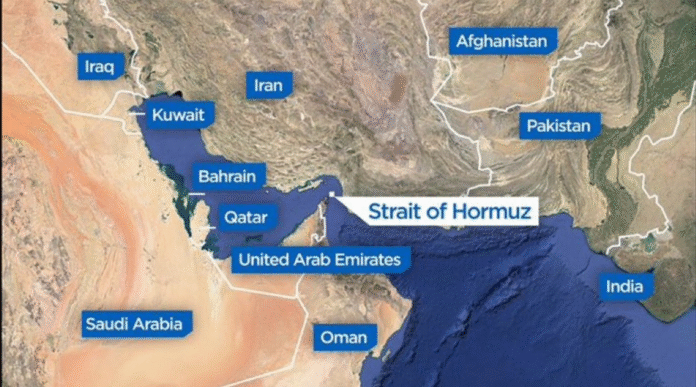
Distant maritime corridors are not abstract lines on a map; they are economic lifelines. Few passages illustrate this more clearly than the Strait of Hormuz — a narrow stretch of water between Iran and Oman that quietly dictates the economic rhythm of much of Asia.
At its narrowest point, Hormuz is barely 33 kilometres wide, with designated shipping lanes only a few kilometres across. Yet nearly one-fifth of the world’s oil supply and a significant share of global liquefied natural gas (LNG) pass through this slender maritime corridor every day. For energy-hungry Asian economies — including India, China, Japan and South Korea — this makes Hormuz less a transit route and more a strategic artery.
Energy Artery Of Asia
Asia is the world’s largest energy-consuming region, but it is heavily dependent on imported hydrocarbons, particularly from the Gulf. Crude oil and LNG exports from Saudi Arabia, Iraq, the UAE, Kuwait and Qatar must first pass through Hormuz before reaching Asian refineries and power plants.
For India specifically, over 80 per cent of crude requirements are met through imports, with a substantial portion sourced from Gulf producers. A large share of that oil transits Hormuz before heading toward refining hubs such as Jamnagar, Mumbai, Mangalore and Kochi. Any disruption — even temporary — can tighten supplies, push up global benchmark prices, and translate directly into higher fuel costs and inflation at home.
A Chokepoint With Global Consequences
What makes Hormuz uniquely powerful is not just volume but concentration. There are limited alternative routes. While Saudi Arabia has pipelines to the Red Sea, their capacity cannot fully compensate for a sustained maritime blockage. The result is that even the threat of instability in the strait can rattle global markets.
Insurance premiums for tankers surge, freight costs rise, and energy-importing nations are forced to dip into strategic reserves. In Asia, where manufacturing, transport, aviation and power generation depend on stable fuel supplies, the ripple effects can be swift and wide-ranging.
Beyond Oil: Trade And Supply Chains
The strait’s importance extends beyond crude. Petrochemicals, refined fuels and LNG cargoes vital to electricity grids across Asia move through the same corridor. When tensions escalate in the Gulf, Asian stock markets often react immediately — a reminder that geography and finance are tightly linked.
Moreover, Hormuz connects to other fragile maritime chokepoints such as the Bab el-Mandeb and the Suez Canal. A disruption at one node can cascade across supply chains, forcing ships to take longer routes and inflating global shipping costs.
Why It Dictates India’s Economic Weather
For India, the Strait of Hormuz is effectively a pressure valve for inflation and fiscal stability. A spike in crude prices widens the current account deficit, strains government subsidy budgets, and increases input costs for industries ranging from transport to fertilisers.
Strategic Petroleum Reserves and supplier diversification — including increased purchases from Russia and the United States — provide partial insulation. But the geographic reality remains unchanged: the bulk of Gulf energy exports must pass through Hormuz.
In times of geopolitical calm, the strait fades into the background of global trade. In moments of conflict, it becomes the world’s most closely watched waterway. For Asia — and particularly for India — Hormuz is not merely a maritime passage; it is the narrow gateway through which economic stability flows.