

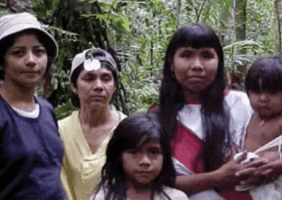
Deep within Brazil’s Amazon rainforest, the Amondawa tribe lives without a conventional understanding of time as defined by modern civilisation. Researchers have found that the indigenous community has no linguistic or cultural equivalent for words such as “time”, “week”, “month” or “year”. Their daily lives are structured around natural cycles rather than clocks or calendars.
A study by scholars from the University of Portsmouth, published in the journal “Language and Cognition”, examined how the tribe conceptualises events and existence.
Language Without Measurable Time
The Amondawa language contains no terms referring to measurable units of time. While members can describe sequences of events, they do not treat time as an abstract, independent dimension.
Professor Chris Sinha of the University of Portsmouth clarified that the tribe is not “without time”. Instead, it does not conceptualise time in the linear and quantified manner typical of industrial societies. Sunrise, sunset and seasonal rhythms guide daily routines.
Identity Over Numerical Age
One of the most distinctive aspects of Amondawa society is the absence of numerical age. Birthdays are not recorded, and individuals do not calculate how old they are.
Instead, life stages are marked by identity changes. As children grow, they receive new names, and a person may change names several times during a lifetime. Social identity, rather than chronological measurement, defines maturity and status within the community.
Challenges of Modern Contact
Increasing contact with the outside world has exposed cultural gaps. Administrative requirements such as identity documents and passports pose difficulties because dates of birth are not recorded.
Efforts are under way to teach Portuguese to facilitate interaction with government systems. However, scholars warn that such integration may gradually erode traditional language and cultural practices.
Important Facts
- The Amondawa tribe lives in the Amazon rainforest of Brazil.
- Their language lacks terms for measurable time units such as year or month.
- Life stages are marked by name changes rather than numerical age.
- The study was published in the journal Language and Cognition.
Living in the Present
The Amondawa experience life primarily in the present, guided by environmental rhythms instead of fixed schedules. Their worldview challenges assumptions that time measurement is universal. The tribe’s way of life offers rare insight into how language shapes perception, even as modern pressures threaten the continuity of this unique cultural framework