

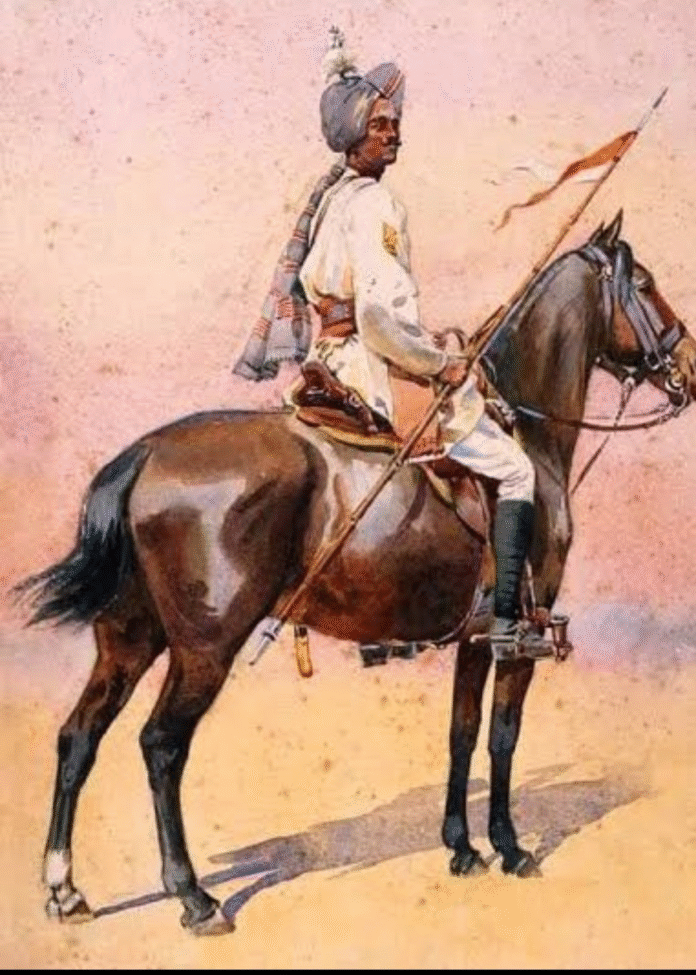
Major Dalpat Singh Deoli, a native of Pali district in Rajasthan, led the Jodhpur Lancers during World War I and became immortal for his extraordinary courage in the Battle of Haifa. On September 23, 1918, he played a decisive role in liberating the Israeli port city of Haifa from Ottoman Turkish forces. Even today, Israel remembers and salutes his sacrifice.
Referring to his bravery during a recent address in Ajmer, Prime Minister Narendra Modi said, “I had the opportunity to salute the bravery of Major Dalpat Singh in the Israeli Parliament.” He described the Rajasthan-born officer as a warrior who made a historic contribution to the liberation of Haifa.
A Braveheart from Deoli Village
Major Dalpat Singh was born on January 26, 1892, in Deoli village of Pali district. He belonged to the Ravan Rajput community. His father, Colonel Hari Singh, was an army officer and an accomplished polo player. Dalpat Singh pursued his higher education at Eastbourne College in England before joining the army at the age of 18. He was commissioned into the famed Jodhpur Lancers.
Before the Battle of Haifa, he had also participated in operations against German forces in France in 1914 during the early years of World War I.
The Battle of Haifa: Swords Against Cannons
The historic Battle of Haifa was fought on September 23, 1918. At the time, Haifa—then under Ottoman control—was strategically important for British forces. Acting under British command, Indian cavalry units, including the Jodhpur Lancers, were tasked with capturing the city.
Despite facing heavy artillery and machine-gun fire, Major Dalpat Singh led around 1,000 cavalrymen armed primarily with swords and spears. In a swift and daring charge, the Indian troops overpowered Turkish forces within hours. The battle is remembered as a rare instance in modern warfare where cavalry defeated well-entrenched artillery positions.
During the intense fighting, Major Dalpat Singh was struck by machine-gun bullets in the spine. Though critically wounded, he continued to lead his men until victory was secured. He succumbed to his injuries a few hours later.
For his exceptional bravery, he was posthumously awarded the Military Cross by the British government. Owing to his heroism, he came to be known as the “Hero of Haifa.”
Honoured in India and Israel
In Israel, the legacy of Major Dalpat Singh is deeply respected. September 23 is commemorated as “Haifa Day,” and his role in the city’s liberation is acknowledged in historical accounts. In India, his equestrian statue stands in front of Teen Murti Bhavan in New Delhi, and another statue was installed on Residency Road in Jodhpur in 2018.
The Battle of Haifa, in which Indian cavalry units from Jodhpur, Hyderabad, and Mysore participated, marked a significant chapter in World War I. It contributed to the eventual collapse of Ottoman control in the region and remains a symbol of extraordinary courage and sacrifice.
More than a century later, Major Dalpat Singh’s story continues to inspire pride in Rajasthan and across India, while also serving as a historic bridge of respect between India and Israel.