

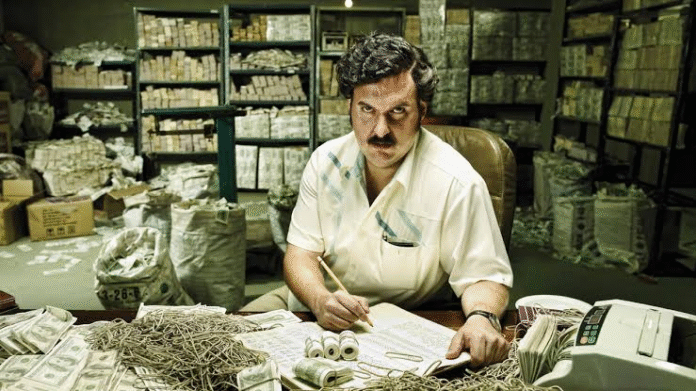
Pablo Emilio Escobar Gaviria was born on December 1, 1949, in Rionegro, Colombia, into a humble family. His father was a farmer, and his mother worked as a schoolteacher. Soon after his birth, the family moved to Envigado, a suburb of Medellín—an area that would later become synonymous with his criminal empire.
Despite his modest upbringing, Escobar showed early signs of ambition and rebellion. As a teenager, he began engaging in petty crimes, including selling fake diplomas, smuggling stereo equipment, stealing tombstones to resell, and car theft. His first arrest came in 1974, marking the beginning of a criminal trajectory that would eventually change Colombia’s history.
Entry into the Drug Trade and the Rise of the Medellín Cartel
As Colombia’s cocaine industry expanded in the 1970s—due to its proximity to coca-growing nations like Peru, Ecuador, and Bolivia—Escobar transitioned from small-time crime to drug smuggling. He helped establish what would later become known as the Medellín cartel, partnering with the powerful Ochoa brothers.
By the mid-1980s, Escobar had become the cartel’s undisputed leader, overseeing the production, transport, and global distribution of cocaine. He was soon regarded as the world’s most powerful drug trafficker, with estimates placing his net worth at around $25 billion.
A Life of Wealth, Power, and Public Image
Escobar’s wealth funded an extravagant lifestyle. His sprawling Hacienda Nápoles estate, worth millions of dollars, featured a private airstrip, a soccer field, artificial lakes, luxury facilities, and a zoo with exotic animals like giraffes and hippopotamuses.
At the same time, he cultivated a Robin Hood–like image by funding housing projects, football fields, and welfare programs for the poor. This popularity helped him win election to an alternate seat in Colombia’s Congress in 1982, blending criminal power with political influence.
Ruthlessness and the Reign of Terror
Despite his philanthropy, Escobar ruled through fear. His infamous policy of “plata o plomo”—silver (bribes) or lead (bullets)—became a symbol of Colombia’s drug-era violence. Judges, police officers, politicians, journalists, and civilians were targeted.
One of the most notorious incidents occurred in 1989, when the cartel bombed a commercial airplane in an attempt to kill an informant, killing more than 100 people. Escobar also fiercely opposed extradition to the United States, famously saying he would rather die in Colombia than be imprisoned in the U.S.
Surrender, La Catedral, and Escape
In 1991, amid escalating violence and pressure, Escobar surrendered after Colombia banned extradition in its new constitution. However, his imprisonment was anything but ordinary. He built a luxurious prison called La Catedral, complete with a nightclub, sauna, waterfall, and football field—where he continued running his criminal operations.
When authorities attempted to move him to a stricter facility in 1992, Escobar escaped, triggering one of the largest manhunts in Colombian history, aided by U.S. agencies and rival cartels.
Death and the Collapse of an Empire
On December 2, 1993, just a day after his 44th birthday, Colombian security forces located Escobar’s hideout in Medellín. A gunfight ensued, and he was killed while attempting to flee across rooftops. Some theories suggest suicide, but official accounts confirm he died in the shootout.
Following his death, the Medellín cartel collapsed, marking the end of an era that had reshaped global drug trafficking and Colombian society.
Legacy: Crime, Culture, and Controversy
Pablo Escobar remains one of the most infamous criminals in modern history. His life story—marked by extreme wealth, brutal violence, and political influence—has inspired countless books, films, and television series. To some, he was a criminal mastermind; to others, a symbol of corruption and bloodshed.
Quick Facts
- Full Name: Pablo Emilio Escobar Gaviria
- Born: December 1, 1949, Rionegro, Colombia
- Died: December 2, 1993, Medellín, Colombia
- Age at Death: 44
- Known For: Leader of the Medellín cartel, global cocaine trafficking empire