

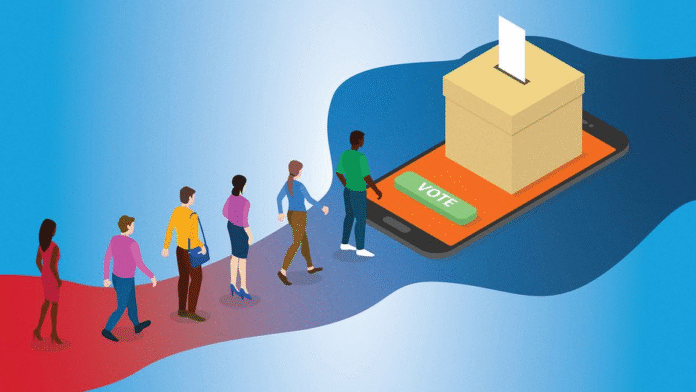
Bihar has taken a major step in digital governance by showcasing an AI-powered mobile-based remote e-voting system at the India AI Impact Summit 2026. Presented by the Bihar State Election Commission, the system is designed to enhance voter accessibility and participation by enabling citizens to vote securely through their smartphones.
The platform was first deployed during the 2025 urban local body elections and is being considered for wider use in future Assembly elections.
India’s First Mobile-Enabled Remote Voting Platform
Bihar’s model is being positioned as India’s first mobile-enabled remote voting system. The dedicated Android application, “e-Voting SECBHR”, has been developed by the Centre for Development of Advanced Computing (C-DAC) in collaboration with the State Election Commission.
The initiative aims to help voters who are unable to visit polling booths, including migrant workers, students, senior citizens, pregnant women, persons with disabilities and the critically ill.
Verification Process and Technology Framework
To cast a vote, users must download the official application and verify their identity through OTP authentication, followed by AI-based facial recognition and live selfie verification, matched with the Electors Photo Identity Card (EPIC) database.
The system uses dual encryption, liveness detection and blockchain-backed storage. Votes are encrypted, anonymised and stored on a decentralised ledger, with decryption allowed only after polling ends through multi-factor authentication and digital signatures by authorised officials. An audit trail similar to VVPAT has also been integrated.
Security and Privacy Measures
Election officials claim blockchain technology ensures tamper resistance, as altering a vote would require rewriting the entire distributed ledger. Voter identity is separated from ballot choice to maintain secrecy, while post-poll hash verification ensures transparency.
Key Facts
- EPIC: Electors Photo Identity Card issued by the Election Commission
- C-DAC: Under the Ministry of Electronics and Information Technology
- Blockchain: Decentralised ledger for secure data storage
- VVPAT: System to verify votes in Electronic Voting Machines
Concerns and Limitations
Despite strong safeguards, experts have raised concerns about impersonation risks, device sharing, facial recognition errors and biometric data privacy. Currently, the system is limited to Android devices, which may affect universal access. During the pilot phase, 3,830 mock registrations were completed out of 14,804 attempts, indicating technical feasibility but room for improvement.