

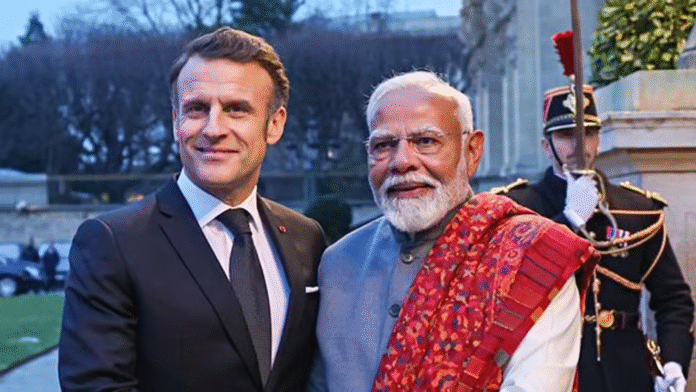
Prime Minister Narendra Modi and French President Emmanuel Macron are set to meet in Mumbai on Tuesday, in what could mark a historic milestone in India–France strategic relations. The meeting is expected to culminate in a massive defence deal worth ₹3.25 lakh crore (approximately $40 billion), under which India will acquire 114 Rafale fighter jets—the largest military procurement in the country’s history by value.
The talks, scheduled for 3:15 PM at Mumbai’s Lok Bhavan, will cover a wide range of issues including defence cooperation, maritime security, Indo-Pacific strategy, emerging technologies, artificial intelligence, and global geopolitical challenges. Later in the evening, the two leaders will inaugurate the India–France Innovation Year 2026, engaging with industry leaders, startup founders, researchers, and innovation experts.
President Macron’s visit to India from February 17 to 19 also includes participation in the AI Impact Summit in New Delhi, underscoring the growing technology partnership between the two nations.
Why This Deal Is a Game-Changer for India
1. Biggest Defence Deal in India’s History
The proposed Rafale acquisition is set to become India’s largest defence procurement ever, surpassing all previous military contracts in financial scale. This deal significantly strengthens India’s air power at a time when regional security dynamics in the Indo-Pacific and along the borders with China and Pakistan are evolving rapidly.
2. India to Get Advanced ‘Super Rafale’ Jets
A key highlight of the agreement is that 24 of the 114 jets will be “Super Rafale” (F-5 version)—the most advanced variant under development by Dassault Aviation.
- Most jets in the deal will be F-4 variant, featuring upgraded sensors, AI-assisted systems, improved radar, and enhanced electronic warfare capabilities.
- The F-5 Super Rafale, expected post-2030, will represent a next-generation upgrade with cutting-edge stealth and network-centric warfare capabilities.
Currently, the Indian Air Force (IAF) operates F-3 Rafale jets, which are already considered 4.5-generation fighters. The new variants will push India closer to fifth-generation capabilities without waiting for indigenous platforms.
3. Massive Boost to Air Force Strength and Technology
The induction of 114 Rafale jets will dramatically increase the IAF’s combat strength, precision strike capability, and deterrence posture. Rafale aircraft are equipped with:
- Meteor long-range air-to-air missiles
- SCALP cruise missiles for deep-strike missions
- MICA missile systems for multi-role combat
- Advanced radar and electronic warfare suites
These capabilities allow India to conduct air superiority missions, deep strikes, nuclear deterrence roles, and network-centric warfare operations.
4. Strengthening Strategic Partnership with France
India and France have shared a strategic partnership since 1998, collaborating in defence, space, nuclear energy, and technology. France has consistently supported India’s strategic autonomy, making it one of India’s most trusted defence partners.
Macron’s visit—the fourth since becoming President—signals deepening trust and alignment between the two democracies in a multipolar world order.
5. Technology Transfer and Defence Ecosystem Growth
Large-scale Rafale procurement is expected to come with technology transfer, local manufacturing, and industrial collaboration, boosting India’s defence manufacturing ecosystem under the ‘Make in India’ initiative. This can strengthen Indian private and public defence companies and create high-skilled jobs.
6. Learning from the First Rafale Experience
India had earlier purchased 36 Rafale jets in a €7.8 billion deal in 2016, with deliveries completed by 2022. These jets are deployed at Ambala (Haryana) and Hasimara (West Bengal) and have already proven to be a major technological leap for the IAF.
The success of the first batch has paved the way for this mega acquisition, giving the Air Force confidence in Rafale’s performance, reliability, and strategic value.
Beyond Defence: Innovation and Indo-Pacific Strategy
Apart from defence, Modi and Macron’s discussions will focus on AI, emerging technologies, maritime cooperation, and Indo-Pacific security architecture. The India–France Innovation Year 2026 reflects a broader partnership beyond weapons—towards research, startups, and deep-tech collaboration.
Conclusion: A Strategic Leap for India
If finalized, this Rafale mega deal will not only modernize India’s Air Force but also reshape its strategic posture in Asia and the Indo-Pacific. With advanced aircraft, deeper technology partnerships, and strong diplomatic alignment with France, India is positioning itself as a major military and technological power in the 21st century.