

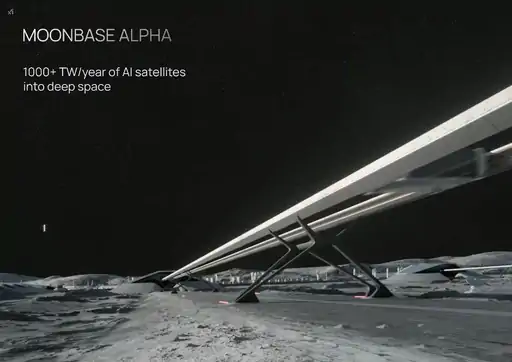
Elon Musk, the world’s richest man, has revealed plans to establish an AI satellite factory on the Moon. According to Musk, the goal is to capture solar energy on an unprecedented scale. He shared this vision in a 45-minute video of an internal meeting at his AI company, xAI.
Here are 8 key takeaways from that meeting:
1. Harnessing Solar Energy & The Dyson Sphere Vision
Musk stated that human civilization currently uses only about 1% of Earth’s potential energy.
He explained that capturing even one millionth of the Sun’s total energy would provide nearly one million times more power than humanity uses today.
Key points from his vision:
- The Sun accounts for 99.8% of the solar system’s mass, making it the ultimate energy source.
- To fully utilize solar energy, humanity must expand beyond Earth.
- Future plans include Earth-orbital data centers, launching 100–200 gigawatts of capacity into space annually with the help of SpaceX.
- To exceed 1 terawatt of energy production, Musk believes operations must move to the Moon.
- Factories built on the Moon will manufacture AI satellites.
- These satellites will be launched into deep space using an electromagnetic launcher known as a “mass driver.”
- Over time, these satellites could form a solar network similar to a Dyson Sphere.
A Dyson Sphere is a theoretical megastructure built around a star to capture a large percentage of its energy output. Musk envisions AI satellites forming a ring-like energy-harvesting system around the Sun, potentially enabling human settlements throughout the solar system and operation of massive interplanetary spacecraft.
2. Six of the 12 Founding Members Fired
Musk revealed significant restructuring within xAI:
- Of the 12 founding team members, only six remain. Several early employees have been laid off. Musk described this as a change in the company’s “organizational structure.”
3. xAI Divided Into Four Major Teams
The company is now structured into four core divisions:
• Grok Team
Focus: Chatbots and voice-based AI systems.
• Coding Team
Focus: Strengthening the app’s technical infrastructure.
• Imagine Team
Focus: Advanced video-generation tools.
• Macrohard Project (Most Ambitious)
The “Macrohard” project aims to:
- Create digital simulations of entire companies.
- Model departments, supply chains, and business decisions.
- Use AI to test consequences of major decisions before real-world implementation.
A major goal is to design complex machinery — including rocket engines — entirely through AI simulation. Musk claims this would:
- Eliminate human error
- Dramatically accelerate engineering development
4. AI Writing Entire Programs Without Human Coding
Musk claimed that AI models now understand problems like experienced engineers.
He predicts that:
- AI will soon detect and fix coding errors independently.
- By the end of the year, traditional coding may no longer be necessary.
- AI could generate programs directly in binary (machine language).
- “Grok Code” may become the world’s most advanced coding model within months.
According to Musk, AI could outperform human programmers and even traditional compilers.
5. AI-Generated 20-Minute Videos
The Imagine Team is working on models capable of generating 10 to 20-minute videos without human intervention by the end of the year.
6. The “Memphis Cluster” – World’s Largest Supercomputer
Musk claims to own the world’s largest GPU cluster, known as the Memphis Cluster.
Key details:
- Operates 24/7
- Designed to train advanced versions of Grok
- Built rapidly — much of the data center was completed in six weeks
- 1,363 kilometers of fiber cables installed
- When fully operational, it will consume over 1 gigawatt of power
Thousands of systems work together like a giant artificial brain.
7. “Macro Hard” Written on the Roof
At the facility, the phrase “Macro Hard” was reportedly written on the roof — symbolizing the ambition behind the large-scale AI simulation project.
8. Musk’s Belief in “Compute Advantage”
Musk attributes much of his success to what he calls “compute advantage” — the idea that the entity with the most computational power will dominate AI development.