

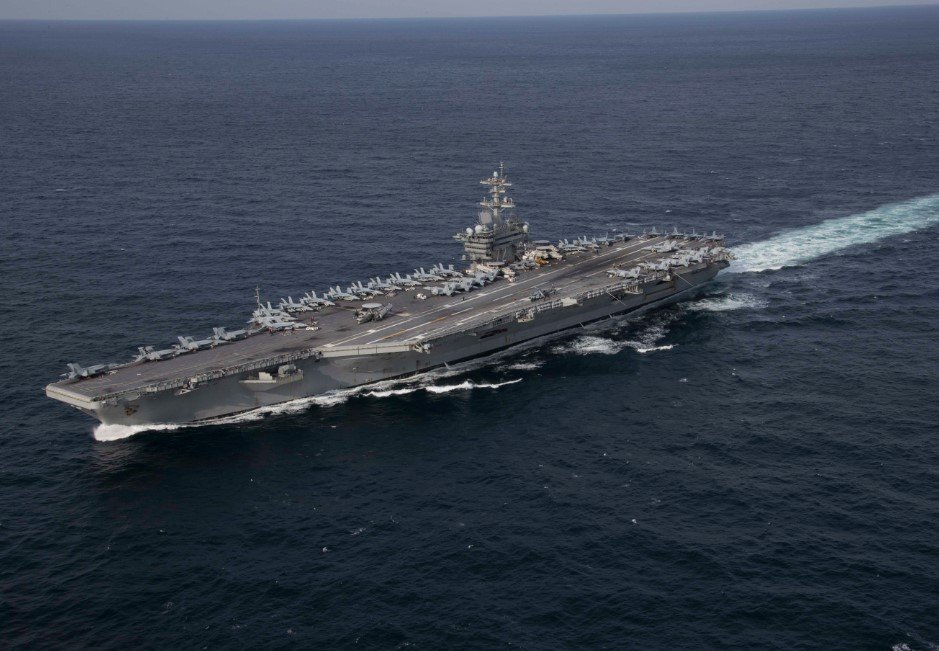
In an era dominated by satellite navigation and advanced radar systems, the US Navy’s nuclear-powered aircraft carrier USS Abraham Lincoln has reportedly adopted an old-school approach while operating in the Arabian Sea. The carrier strike group is navigating without active GPS or radar, relying instead on traditional navigation techniques to avoid electronic detection in a highly sensitive maritime zone.
Why USS Abraham Lincoln is avoiding GPS in the Arabian Sea
Modern naval ships depend heavily on GPS for precise positioning. However, GPS signals can be jammed, spoofed or manipulated, especially in regions where electronic warfare capabilities are actively deployed. In contested waters like the Arabian Sea, constant GPS use can expose a ship’s location to adversaries. By switching off these systems, the USS Abraham Lincoln significantly reduces its electronic footprint.
Celestial navigation techniques used by US Navy warships
To maintain course without satellite assistance, the carrier is reportedly using celestial navigation. This centuries-old method calculates a vessel’s position by observing celestial bodies such as the sun, moon and stars. Using sextants and manual calculations, trained naval officers can determine latitude and longitude with surprising accuracy. The technique remains reliable even when modern systems fail or are deliberately disabled.
How dead reckoning supports navigation without radar
When celestial observation is not possible due to weather conditions, the crew relies on dead reckoning. This method estimates the ship’s position based on speed, direction and time travelled, while factoring in wind and ocean currents. Though less precise over long distances, dead reckoning is effective for short-term navigation and serves as a crucial backup in radar-free operations.
Emission control strategy to avoid enemy surveillance
The USS Abraham Lincoln is believed to be operating under strict emission control protocols, often referred to as Ghost Mode. Radar systems, GPS transmitters and automatic identification signals are switched off to prevent detection by hostile surveillance systems. Instead, visual lookouts equipped with night-vision devices and coordination with escort vessels ensure situational awareness.
Why electronic warfare threats are reshaping naval operations
The move reflects growing concerns over electronic warfare in strategic sea routes. The Arabian Sea lies within a region of heightened geopolitical tension, where signal interference has become increasingly common. The US Navy has been re-emphasising traditional navigation training in recent years to prepare crews for such scenarios.
Old navigation skills proving vital in modern warfare
While the US Navy has not officially detailed the operation, the reported strategy highlights a key reality of modern military operations. Even the most advanced warships must be prepared to operate without digital systems. By blending traditional seamanship with modern firepower, the USS Abraham Lincoln showcases adaptability as a critical strength in contemporary naval warfare.