

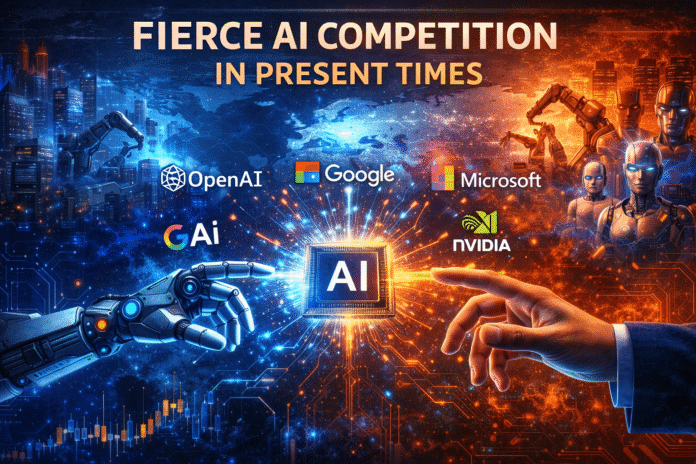
Artificial intelligence is no longer a distant promise – it is the engine driving today’s biggest technological shifts. In present times, AI competition has become fierce, fast-paced, and global, with companies racing not just to build smarter systems, but to shape how economies, workplaces, and everyday life will function in the years ahead. What we are witnessing is not a single contest, but a multi-front race involving innovation, speed, trust, scale, and real-world impact.
Why the AI Race Has Intensified
The rapid progress of large language models, generative AI, autonomous systems, and AI-powered tools has dramatically lowered the barrier between experimentation and mass adoption. Startups can now challenge tech giants, while established companies are under constant pressure to reinvent themselves.
Cloud computing, open-source models, and massive investments have accelerated development cycles. As a result, product launches that once took years now happen in months. In this environment, standing still is not an option – companies must either innovate continuously or risk being left behind.
Beyond Technology: A Battle of Ecosystems
Today’s AI competition goes far beyond algorithms. It is about who builds the strongest ecosystem – integrating AI into operating systems, enterprise software, education, healthcare, finance, and consumer products. Companies are competing to become the default AI platform that people and businesses rely on daily.
At the same time, nations are investing heavily in AI as a strategic asset. Governments view leadership in artificial intelligence as essential to economic growth, national security, and global influence. This has turned AI into both a commercial and geopolitical contest.
Speed vs Responsibility
One of the defining tensions in the current AI race is the balance between speed and responsibility. While competition pushes companies to release faster and more powerful tools, public scrutiny is increasing around issues like data privacy, bias, misinformation, job displacement, and energy use.
In present times, success in AI is no longer measured only by technical superiority. Trust, transparency, and usefulness are becoming just as important. Companies that fail to align innovation with social value risk backlash from users, regulators, and governments.
Opportunities Created by Fierce Competition
Despite the intensity, fierce AI competition has clear benefits:
- Faster innovation: Competition accelerates breakthroughs and lowers costs.
- Wider access: More players mean AI tools are becoming accessible to small businesses, creators, and individuals.
- Diverse solutions: Different approaches lead to specialization across industries and use cases.
- Economic transformation: AI is creating new roles, skills, and productivity gains across sectors.
For users, this means better tools, smarter services, and more choices than ever before.
What the Future Looks Like
As AI competition continues to intensify, the focus is likely to shift from who builds the most powerful model to who delivers the most meaningful impact. The next phase of the AI race will reward companies that solve real problems, integrate seamlessly into human workflows, and earn long-term trust.
Rather than a winner-takes-all outcome, the future of AI may belong to those who collaborate, adapt quickly, and use competition as a catalyst for progress rather than conflict.
Conclusion
Fierce AI competition in present times reflects a pivotal moment in technological history. The race is reshaping industries, redefining leadership, and influencing how society interacts with machines. While the pace is intense and the stakes are high, this competition is also driving innovation that has the potential to improve lives on a global scale.
In the end, the true winners of the AI race will not just be companies or countries – but the people who benefit from technology that is powerful, responsible, and genuinely useful.