

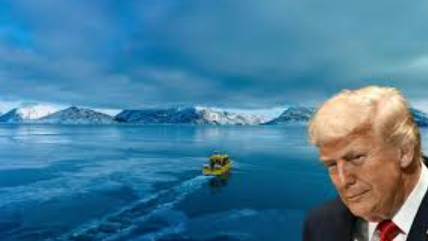
On January 21, 1968, a United States Air Force bomber carrying four thermonuclear weapons crashed onto the frozen ice near Thule Air Base in Greenland. What followed — radioactive contamination, secret diplomacy, and the silencing of Indigenous voices — was not an aberration. It was a revelation. More than half a century later, as former U.S. President Donald Trump speaks openly about acquiring Greenland that crash reads less like a Cold War accident and more like an early chapter in a long story of strategic control overriding sovereignty and consent.
The 1968 Thule crash and the nuclear secret
The aircraft involved was a B-52 bomber of the United States Air Force, flying a routine Strategic Air Command mission under Operation Chrome Dome — continuous airborne nuclear patrols designed to deter the Soviet Union. A fire in the heating system forced the crew to abandon the aircraft, which slammed into the ice near Thule Air Base.
The nuclear warheads did not detonate, but their conventional explosives did, scattering plutonium-contaminated debris across more than five miles of ice. Declassified documents show that U.S. recovery teams worked in near-total darkness, sub-zero temperatures, and violent Arctic storms. Over 10,000 cubic metres of radioactive ice and snow were eventually scraped up and shipped to Savannah River, South Carolina. One critical fissile component — the ‘spark plug’ of a thermonuclear weapon — was never recovered, despite underwater searches in North Star Bay.
The crash also exposed a diplomatic lie. Denmark had publicly declared itself nuclear-free in peacetime, yet had quietly tolerated U.S. nuclear deployments over and around Greenland since 1957. Secretary of State Dean Rusk was forced into damage control, negotiating wording that would reconcile Denmark’ public policy with its tacit acquiescence. Danish officials privately acknowledged that the agreement was “less than binding”, while U.S. negotiators insisted that American strategic needs would prevail.
Greenland before Thule: Relocation and colonial control
The Thule incident cannot be separated from Greenland’s longer colonial experience. Danish rule, stretching from the eighteenth century into the late twentieth, systematically subordinated Indigenous Inuit life to external priorities. In 1953, to clear space for the U.S. air base, the Inuit community of Thule was forcibly relocated to Qaanaaq. Over 130 villagers lost access to ancestral hunting grounds, disrupting food systems, kinship networks, and cultural continuity.
Awards and honors lists
There was no massacre, but the consequences were enduring. A foreign administration dictated settlement patterns, livelihoods, and futures. The crash site itself lay near lands that had only recently been taken from the community — underscoring how military strategy literally displaced Indigenous survival.
Reproductive control and bodily coercion
Control extended beyond land. In the 1960s and 1970s, Danish authorities implemented a systematic programme of reproductive intervention among Greenlandic women and girls. Thousands were fitted with intrauterine devices or subjected to hormonal contraception without informed consent. Some were as young as twelve.
Estimates suggest that around 4,500 women and girls — nearly half of Greenland’s fertile female population at the time — were affected. Many suffered chronic pain, infections, infertility, and lasting psychological trauma. The programme was justified as population management, but functioned as coercive social engineering. Denmark and the Government of Greenland have since apologised and initiated compensation schemes, yet testimonies speak of decades of silence, stigma, and unresolved harm.
Why Greenland mattered to Washington
For the United States, Greenland was never peripheral. The 1951 U.S.–Denmark Defence Agreement granted Washington sweeping operational freedom. NSA archives reveal that U.S. planners viewed Greenland as indispensable for early-warning radar, nuclear deterrence, and North Atlantic power projection. In 1957, the Joint Chiefs of Staff even proposed purchasing or leasing Greenland for 99 years — an idea shelved only because it risked offending Denmark diplomatically.
In practice, U.S. behaviour already assumed strategic entitlement. Nuclear-armed flights passed daily over Greenland, weapons were stored near Inuit settlements, and decisions were made with minimal disclosure. After the Thule crash, the priority was containment of contamination and political fallout — not consultation with local communities whose subsistence hunting was directly threatened.
Trump’s blunt articulation of an old logic
What distinguishes the present moment is not ambition, but candour. Donald Trump has said openly that Greenland is essential to U.S. national security and that “anything less than” American control is unacceptable. He has dismissed Greenlandic leaders asserting autonomy and framed NATO’s strength as dependent on Greenland being “in the hands of the United States”.
This is not a departure from history; it is its explicit continuation. Where Cold War strategists operated through secrecy and euphemism, Trump speaks in the language of real estate and protectionism — a belief that control, not partnership, ensures security.
Resistance, limits, and power imbalance
Danish and Greenlandic officials have resisted. Copenhagen speaks of a “fundamental disagreement”. Nuuk reiterates autonomy and adherence to existing agreements. Yet resistance is structurally constrained. Geography, alliance politics, and U.S. military reach create asymmetries that history suggests are hard to overcome.
European allies have limited leverage when NATO and Arctic security are invoked. Greenlandic voices were marginal in 1953, in 1957, and in 1968 — and remain vulnerable today. The pattern is consistent: strategic imperatives trump local agency.
A continuity of exploitation
From forced relocation to reproductive coercion, from nuclear contamination to contemporary geopolitical bargaining, Greenland has repeatedly been treated as a space to be managed rather than a people with rights. The 1968 Thule crash was not merely an accident; it was a moment when hidden power relations surfaced.
Trump’s statements suggest that what was once implicit is now explicit. The historical record offers little comfort that global strategy will yield to Indigenous consent. As the proverb goes, the powerful watch the prize, the vulnerable watch what lies immediately before them.
For Greenland, history suggests that external ambition does not arrive suddenly. It accumulates — and then declares itself inevitable