

Efficient material flow is the backbone of a well-run warehouse. When goods move smoothly from receiving to storage and finally to dispatch, operations stay predictable and costs remain under control. However, many warehouses still rely heavily on manual handling, which leads to delays, congestion and uneven workflows. As order volumes grow and turnaround times reduce, these issues become harder to ignore.
One preferred way to improve material movement is to use roller conveyor systems. By creating a defined and consistent path for goods, warehouses can reduce handling effort and improve overall efficiency without overcomplicating daily operations.
Understanding Material Flow in a Warehouse
Material flow refers to how goods move through different stages of a warehouse. This includes unloading, inspection, storage, picking, packing and dispatch. When this flow is poorly planned, workers spend more time moving products than processing them. This often results in bottlenecks, misplaced items and increased physical strain.
Good material flow is not only about speed. It is also about consistency and control. Goods should move in a logical sequence with minimal backtracking or manual lifting. Equipment selection plays a key role here. Layout planning and proper handling systems help ensure materials move smoothly without disrupting other activities on the floor.
What is a Roller Conveyor System?
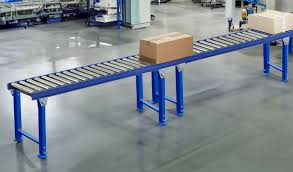
A roller conveyor system uses a series of rollers mounted within a frame to move goods from one point to another. Depending on the application, rollers can be gravity-based or powered. Gravity rollers rely on a slight incline, while powered rollers offer controlled movement across longer distances or flat surfaces.
A motorised roller conveyor uses individual or zoned motors to move items at a controlled speed. This makes it ideal for warehouses that handle cartons, totes or packaged goods. Unlike manual movement, conveyors provide a predictable path that reduces reliance on forklifts and hand carts.
The key advantage lies in controlled transfer. Goods move along a defined route, reducing unnecessary handling and improving coordination between different warehouse zones.
Improving Speed and Consistency in Operations
Manual movement usually creates uneven workflows. Some areas move faster while others slow down due to congestion or fatigue. Roller conveyors help address this issue by creating a steady flow of materials between workstations.
Instead of workers carrying items across long distances, conveyors handle repetitive movement. This enables employees to focus on value-added tasks such as sorting, packing or quality checks. Consistent movement also helps reduce waiting time between processes, especially in high-volume operations.
By integrating conveyors between receiving, storage and dispatch areas, warehouses can ensure a balanced flow that supports daily output targets without regular supervision.
Enhancing Safety and Reducing Manual Handling
Safety is a major concern in warehouses that rely on lifting and carrying. Repeated manual handling increases the risk of injuries and long-term strain. Roller conveyors help reduce this risk by limiting the need for the physical movement of goods.
When materials move along a conveyor, workers interact with them only at defined points. This reduces bending, lifting and twisting motions. Predictable movement paths also improve floor safety, as there is less random traffic across aisles.
A conveyor system does not eliminate the need for people, but it supports safer working conditions by taking over routine and physically demanding tasks.
Supporting Better Space Utilisation and Layout Efficiency
Warehouse space is valuable and poor layouts often lead to wasted floor area. Roller conveyors can be designed to fit within existing layouts, moving goods along straight lines, curves or gentle inclines as needed.
Conveyors help organise material flow by clearly separating movement paths from storage and work areas. This reduces cross-traffic and keeps operations structured. Overhead or elevated conveyor sections can also free up floor space for storage or staging.
When planned properly, conveyors support a cleaner layout where goods move logically from one zone to another without disrupting surrounding activities.
Importance of System Planning and Experience
Installing conveyors without proper planning can create new problems instead of solving old ones. Load type, product dimensions, throughput requirements and future expansion must be considered before finalising a system.
This is where experienced solution providers add value. Companies like Godrej Storage Solutions are involved in designing material handling systems that align with real operational needs. Their approach typically focuses on integration with existing infrastructure, safety compliance and long-term reliability rather than quick fixes.
A well-planned motorised roller conveyor system should blend into warehouse operations and support them quietly over time.
Preparing Warehouses for Scalable Operations
Warehouse demands rarely remain static. Seasonal peaks, business growth and changing order profiles require systems that can adapt. Roller conveyors offer flexibility in this regard.
Additional conveyor lines or zones can be added as volumes increase. Controls can be adjusted to manage different flow rates without redesigning the entire layout. This makes conveyors suitable for warehouses that need to scale gradually.
More importantly, consistent material flow supports better planning as operations grow. When movement remains predictable, it becomes easier to manage labour, space and timelines.
Conclusion
Optimising warehouse material flow is not about adding complexity. It is about ensuring a controlled and reliable movement of goods that supports daily operations. Roller conveyor systems provide a practical way to achieve this by reducing manual handling, improving safety and maintaining consistency.
When designed and implemented thoughtfully, a conveyor system becomes a long-term asset rather than just equipment. With the right planning and experience, solutions like a motorised roller conveyor help warehouses stay efficient, organised and ready for future demands.