

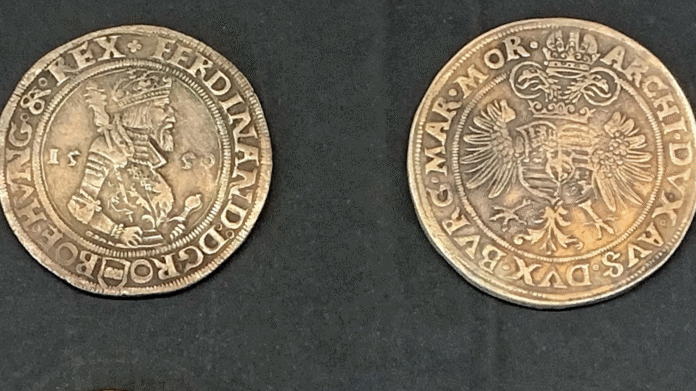
The tiny Czech town of Jáchymov was just named one of Unesco’s newest World Heritage sites – a remarkable honour for a place that birthed the world’s most influential currency yet doesn’t accept it. More than 230 years after the US stopped minting the penny this week, the story of the first dollar traces back not to America, but to a one-road mining town deep in the Bohemian mountains.
The US dollar today is the planet’s most widely used currency. According to the Federal Reserve, 58% of global financial reserves are held in dollars – more than twice the combined foreign holdings of the euro, yen and renminbi. Thirty-one nations have adopted it or named their money after it, 65 peg their currencies to it, and it is accepted everywhere from Siberia to North Korean border towns to research stations at the North Pole.
But in Jáchymov – population 2,300 – your dollar is worthless.
When I pulled out a George Washington one-dollar bill inside the town’s 16th-Century Royal Mint House museum, docent Jan Francovič smiled and shook his head.
“I haven’t seen one of these in a long time,” he said, calling over colleagues. “Here we only take koruna, euros, sometimes Russian rubles. You’re the first American we’ve seen in more than three years.”
A town that shaped the world – and forgot it
Jáchymov sits near the Czech-German border, a jumble of abandoned Gothic and Renaissance buildings spilling down a hill toward a clutch of lavish spas in the valley below. You could wander its length without the slightest hint that this was the birthplace of the dollar.
“There are no signs – most people here don’t even know,” said Michal Urban, head of the development group Mountain Region Krušné hory–Erzgebirge. Guiding me down into the mint’s dark, vaulted basement where the first coins were tested, he added, “No other mining town has had such an influence, but we’ve forgotten our history.”
Where it began: A silver boom and a visionary count
Before Jáchymov existed, the mountains were wilderness. Everything changed in 1516 when vast silver deposits were discovered. Local noble Count Hieronymus Schlick moved fast, naming the area Joachimsthal (“Joachim’s valley”) after the patron saint of miners.
Europe then was a patchwork of city-states minting their own currencies. When the Bohemian Diet granted Schlick permission to mint silver coins on 9 January 1520, he stamped Joachim on one side, the Bohemian lion on the other, and named them “Joachimsthalers” – soon shortened to thalers.
Schlick ensured the thaler’s success by matching its weight and size to the widely used Guldengroschen and flooding the market with coins. Joachimsthal exploded into Europe’s largest mining centre, minting an estimated 12 million thalers by the mid-16th Century – more than any other European currency at the time.
The thaler takes over Europe – and becomes the “dollar”
As Joachimsthal’s mines dwindled, the thaler’s reputation only grew. By 1566, it had become the standard coinage of the Holy Roman Empire, and over the next centuries, countries from Greece to Hungary, Italy to Poland, adopted their own variants.
The name evolved too:
• daler in Scandinavia
• dalur in Iceland
• tallero in Italy
• tolar in Slovenia
• tālā in Samoa
The lion on the earliest thaler even inspired the names of the Romanian leu, Bulgarian lev and Moldovan leu.
But it was the Dutch leeuwendaler (“lion dollar”) that ultimately shaped global economics. Dutch colonists brought the coin to New Amsterdam in the 17th Century, where English settlers began calling all similarly weighted silver coins “dollars”. The US adopted the name officially in 1792 – and the dollar’s rise never stopped.
A darker legacy beneath the mountains
Yet Jáchymov’s history is not only of silver and currency. When the silver ran out, miners hit a sinister black mineral: uraninite, which poisoned workers and killed many. In 1898, Marie Curie identified the ore as containing radium and polonium. Her research won her a Nobel Prize – and led to her death from radiation exposure.
The mines then entered their second act: powering the nuclear age.
During World War Two, Nazis explored atomic research here. Oppenheimer studied the area’s uranium. After the war, the town – renamed Jáchymov – became a Soviet gulag. Between 1949 and 1964, around 50,000 political prisoners were forced to mine uranium to fuel Stalin’s nuclear arsenal.
Remarkably, two of the most potent symbols of modern power – the dollar and the atomic bomb – trace their origins to this quiet valley.
Jáchymov today
The town is still wrestling with its past. Toxic, uranium-tainted homes are being slowly restored. The hulking Svornost mine, which once produced the world’s first dollars, now pumps radon-rich water to luxury spas advertising “radon therapy”.
Yet even today, there isn’t a single sign proclaiming Jáchymov as the birthplace of the dollar. Only inside the Royal Mint House museum will guides proudly show visitors a small frame holding a crisp US one-dollar bill.
This story was originally published in 2020 and has since been updated. (With excerpts from BBC)