

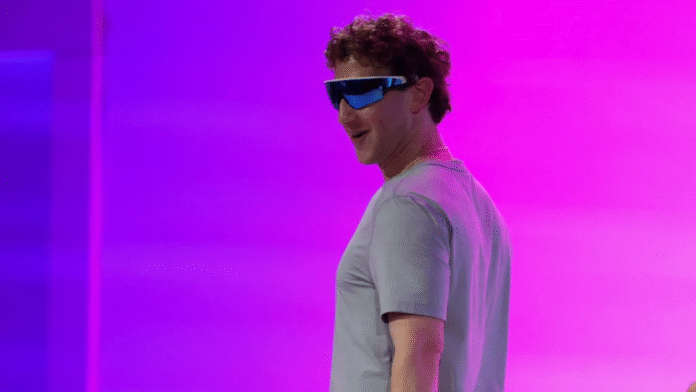
Meta has introduced a new range of smart glasses powered by its cutting-edge artificial intelligence (AI) technology, marking a bold expansion in its push to make these wearable devices a must-have accessory for consumers worldwide. At the company’s annual developer conference, Meta Connect, CEO Mark Zuckerberg unveiled a series of devices in collaboration with popular sunglasses brands Ray-Ban and Oakley.
The highlight of the event was the introduction of Meta’s Ray-Ban Display smart glasses, which feature a full-color, high-resolution screen in one lens, enabling users to conduct video calls and view messages on the go. Additionally, Meta launched a neural wristband, which pairs with the glasses, allowing users to send messages and perform tasks using small hand gestures.
Despite ongoing concerns over the impact of its products, particularly on children, Zuckerberg hailed the technology as a “huge scientific breakthrough” during his keynote to a crowd of hundreds at Meta’s Silicon Valley campus.
The new Meta Ray-Ban Display glasses also come equipped with a 12-megapixel camera, giving users the ability to capture photos and videos hands-free. With Meta AI integrated into the devices, Zuckerberg believes these smart accessories will become a key part of how the company embeds AI into people’s daily lives.
Analysts are optimistic that smart glasses may be more successful than Meta’s previous ventures, such as its multi-billion dollar Metaverse project, which focuses on creating virtual worlds. Unlike VR headsets, smart glasses offer a more practical, everyday form factor. According to Mike Proulx, VP of Research at Forrester, “Unlike VR headsets, glasses are an everyday, non-cumbersome form factor.”
However, convincing the majority of people who don’t yet own AI-powered glasses will be a challenge, according to Proulx. Meta has not disclosed exact sales figures but is estimated to have sold around two million pairs of smart glasses since launching in 2023.
The Meta Ray-Ban Display will be available later this month for $799 (£586), which is significantly higher than the price of Meta’s earlier smart glasses. In addition, Meta unveiled the Oakley Meta Vanguard glasses priced at $499, targeting sports enthusiasts, and a second-generation version of the Ray-Ban Meta glasses priced at $379.
Meta’s ambitious AI investments were also on display, with Zuckerberg announcing plans to invest billions of dollars in building massive AI data centers across the U.S., with one site expected to cover an area nearly the size of Manhattan. This infrastructure will support Meta’s goal of developing superintelligence — AI systems that can surpass human capabilities.
Despite the excitement surrounding Meta’s AI-driven innovations, the company has faced increasing scrutiny from parents and activists. Earlier in the day, protests were held outside Meta’s New York headquarters by activists and families of suicide victims, calling for stronger safeguards for children on social media platforms, including those owned by Meta.