

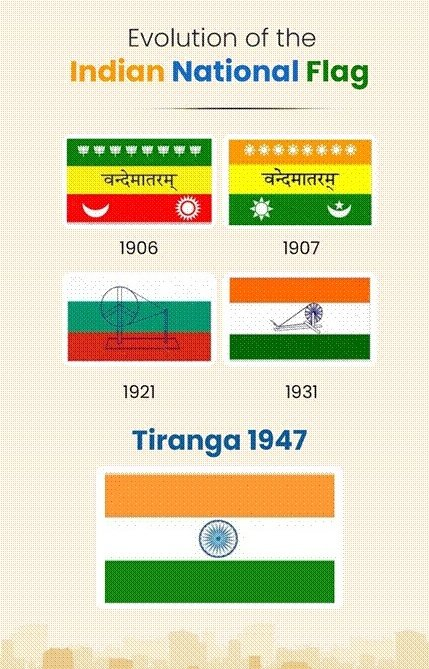
Indian National Flag has an interesting history. What we call Tiranga earlier had a different version. Let’s know the history, meaning and rules of Indian National Flag.
1. When was the National Flag adopted?
The present form of the National Flag of India was officially adopted on July 22, 1947, just weeks before independence from British rule on August 15, 1947.
2. What is it called?
In India, the flag is popularly known as the Tiranga (Tricolour).
3. What do the colours represent?
The flag is a horizontal tricolour of deep saffron at the top, white in the middle, and dark green at the bottom, in equal proportions. In the centre of the white band is the navy-blue Ashoka Chakra with 24 spokes, representing the “Wheel of Law” from Emperor Ashoka’s Sarnath Lion Capital.
- Saffron – Strength and courage
- White – Peace and truth
- Green – Fertility, growth, and auspiciousness of the land
4. Ashoka Chakra – Design and Meaning
The wheel’s diameter matches the width of the white band and has 24 spokes, symbolising life in movement and the rule of law.
5. Official Size and Ratio
The flag must be rectangular with a length-to-height ratio of 3:2.
6. Evolution of the Flag
- 1904: Sister Nivedita designed an early flag with yellow and red, a white lotus, the phrase Bonde Mataram, and the ‘Vajra’ symbol.
- 1921: Mahatma Gandhi asked Pingali Venkayya to design a flag with a Charkha (spinning wheel) for self-reliance.
- 1931: A flag committee replaced the Charkha with Ashoka’s Dharma Chakra.
- 1947: The Constituent Assembly adopted the current Tiranga.
7. Rules for Display (Flag Code of India, 2002 & Prevention of Insults to National Honour Act, 1971)
- Must never be inverted, damaged, or allowed to touch the ground or water.
- No lettering, decoration, or use as clothing below the waist.
- Must not be used to wrap, cover, or drape objects/vehicles.
- Always occupy the position of honour when displayed.
8. Disposal of the Flag
Damaged flags must be destroyed privately, preferably by burning, with dignity. Paper flags should also be disposed of respectfully.
9. Permissible Materials
Since December 2021, flags can be handspun, handwoven, or machine-made from cotton, polyester, wool, silk, or khadi.