

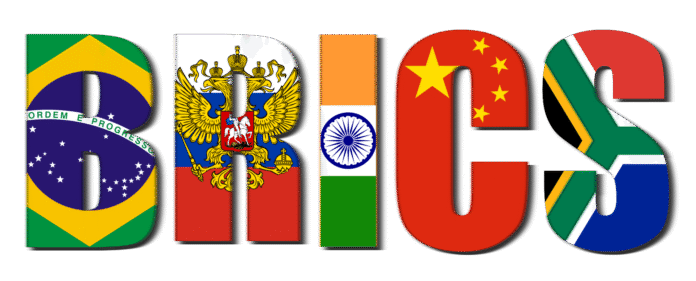
Is the era of America’s centuries-old hegemony finally coming to an end? The United States — which has long dominated the world in nearly every aspect, whether military, technology, or culture — now appears to be gradually losing its grip, particularly with the rise of BRICS nations. BRICS has emerged as a significant platform that advocates for the Global South and challenges the dominance of the Western-led world order.
Following the recent BRICS summit, a concept that has gained notable attention is “De-Americanization” — the idea of reducing global dependency on the United States across major domains. This article explores why BRICS seeks to ‘De-Americanize’ the global system, how this shift holds the potential to redefine global power structures, challenge long-standing Western dominance, and offer a more multipolar vision for the future of international relations.
BRICS Bloc with 11 Member states (Brazil, Russia, India, China, South Africa, Iran, Indonesia, Others) now represent roughly 50% of the Global Population and 40% of Global GDP surpassing the G7. The main aim of these countries is to promote South-South cooperation, currency/resource independence, economic sovereignty and institutional reforms, which will create a more equitable world order that will reduce the economic and political dominance created by the US. This is the main reasons BRICS Nations considers De-Americanization as a Global Priority.
De-Americanization clearly means reducing America’s political, economic and cultural influence on the world, ending Western dominance and establishing a multipolar world order.
The BRICS bloc is now moving forward with this ideology and challenging the dominance of America through its expansion (BRICS+), policy of de-dollarization and Technological independence as collective voice of Global South. Although the BRICS Nations do not directly claim that they are promoting anti-American sentiment, they rather say that now the world does not need the domination of any single country. During the 2025 BRICS Summit in Rio, Brazilian President Luiz Inácio Lula da Silva criticized U.S. dominance, stating, “We don’t want an emperor,” in reference to Donald
Trump’s tariff threats, according to a report by The Times of India (2025).
The West’s response to BRICS’ growing momentum toward De-Americanization has been a complex mix of denial, strategic counterbalancing, and quiet concern. While BRICS openly promotes a multipolar world based on equality and sovereignty, Western powers; particularly the United States and its allies—view this agenda as a direct challenge to their post-World War II leadership model.According to Reuters ,NATO Secretary General Mark Rutte warned that countries such as Brazil, China and India could be “hit very hard by secondary sanctions” if they continued to expand economics ties with Russia under the BRICS Framework. Reuters. (2025, July 15). NATO says Brazil, China, India could be hit hard by sanctions. U.S President Donald Trump openly criticized the 2025 BRICS Summit, accusing its “Anti-American policies”.
As per reports of Times of India ,Trump warned the countries aligning with BRICS’ De-Americanization agenda would face “An additional 10% tariff with no exceptions.” Times of India. (2025, July 18).
‘Little group fading fast’: Donald Trump mocks BRICS; reiterates 10% tariff threat to protect US dollar dominance.
BRICS undoubtedly poses a significant challenge to American dominance. Given its steady expansion and growing influence, it appears poised to reshape the global balance of power.
In the years to come, we may witness not just the decline of unipolarity, but the emergence of a new, multipolar world order—one that reflects a broader spectrum of voices, values, and visions for the future.

(The writer is Isha Singh Chouhan, pursuing M.A Political Science, student Kanoria P.G Mahila Mahavidyalaya)