

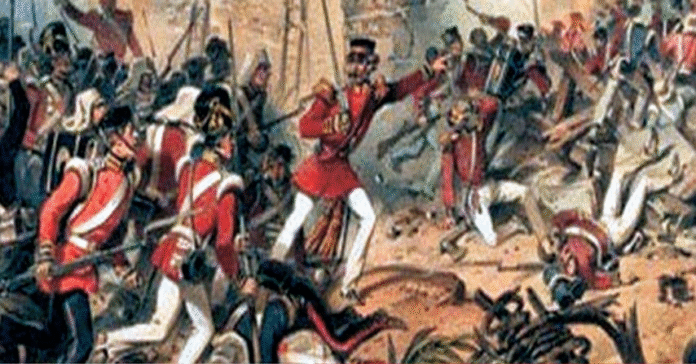
It is a deeply thought-provoking question: how could a spice-trading company, the East India Company, enter a vast and culturally rich land like India and ultimately dominate it? The British came to India under the guise of trade and established the East India Company. Over time, using a combination of diplomacy, deceit, and military power, the British began to occupy various regions across the country. The turning point came with the Battle of Plassey in 1757, where the East India Company defeated Siraj-ud-Daulah and began asserting direct control over Indian territories.
At the time, many regions in India were under the control of the Mughal Empire and local kings. Rajputana (present-day Rajasthan), with its famed wealth and valor, attracted British interest. Governor-General Sir Charles Metcalfe initiated a series of treaties with the princely states of Rajputana. These agreements required the local rulers to pay khiraj (tax) to the British in exchange for protection, with a promise of non-interference in internal matters.
However, these treaties gradually weakened the economic condition of the rulers while strengthening British control. The East India Company imposed additional taxes, beyond the agreed khiraj, and began to interfere in regional governance. Cottage industries were destroyed, the production of salt and opium was banned, and arbitrary taxes were levied. When taxes were unpaid, the British confiscated land and property, ended royal succession rights, and even began to alter cultural and religious traditions. Christian missionaries were deployed to convert locals, sometimes through incentives like tax exemptions. This intrusion into personal and societal spheres created widespread resentment.
The Spark of Revolution in Nasirabad
This growing discontent erupted into revolution. On 28 May 1857, the spark of rebellion ignited in Rajasthan at Nasirabad. Revolutionaries seized the artillery and killed Major Spottiswoode and Colonel Newbury. Churches and official bungalows were set on fire, and the British treasury was looted. The rebels set their sights on Delhi to seek leadership from Mughal emperor Bahadur Shah Zafar.
The rebellion soon spread. When the news reached Neemuch, Colonel Abbott tried to enforce loyalty by making Hindu soldiers swear on the Bhagavad Gita and Muslim soldiers on the Qur’an. But soldier Mohammad Ali Baig of Awadh questioned this loyalty, highlighting British betrayal in his homeland. On 3 June 1857, Hindu and Muslim soldiers jointly rebelled, looted the Neemuch cantonment, and set out for Delhi via Deoli, Tonk, and Agra.
Rebellion Spreads Across Rajputana
In Erinpura, the Jodhpur Legion, stationed at Sirohi, revolted on 21 August 1857. On 23 August, leaders like Moti Khan, Sheetal Prasad, and Tilak Ram raised the slogan “Chalo Delhi, Maro Firangi” (Let’s go to Delhi, kill the foreigners). The revolutionaries looted the Erinpura station and reached Pali, where they joined forces with Thakur Kushal Singh Champawat of Auwa village. With support from local Thakurs, Kushal Singh raised an army of 6,000 men.
On 8 September, his forces defeated the royal army of Jodhpur at the Battle of Bithora. Chief commander Onad Singh was killed, and Captain Heathcote fled. Another victory followed at Chelawas on 18 September. Revolutionaries, led by Thakur Shivnath Singh of Asop, aimed for Delhi but were halted and defeated at the Battle of Narnaul.
On 20 January 1858, the British, under Brigadier Holmes, launched an assault on Auwa. Local villagers fiercely resisted for three days. On 24 January, the British captured the Auwa fort through the betrayal of its keeper. In retaliation, they plundered the village, destroyed temples, and exploded the fort using gunpowder. They looted the idol of Sugali Mata—the goddess of revolution—along with cannons and gunpowder.
Kota’s Fierce Revolt
Kota witnessed the most violent and organized uprising. On 15 October, Lala Jaydayal and Risaldar Mehrab Khan led the revolution, setting fire to the Residency and killing Major Burton, his two sons, and several British officers. The revolutionaries paraded Burton’s head through the city. The Maharao of Kota was confined in the fort, and efforts to suppress the revolt failed. British control was reestablished on 30 March 1858 under General Roberts. Jaydayal was betrayed and arrested, Mehrab Khan was executed, and Jaydayal was blown from a cannon at the spot where Burton was killed.
People’s Support and Widespread Resistance
Elsewhere, Gurjar leaders like Devi Singh and Bhawani Shankar of Dholpur raised 3,000 soldiers, later joined by 5,000 from Gwalior and Indore. In Tonk, women played an active role in the uprising, the only such instance in Rajasthan. The Nawab’s attempts to suppress the rebellion failed.
The revolt wasn’t limited to soldiers—civilians, monks, and local leaders also played vital roles. Sikar’s Dungar Ji and Jawahar Ji repeatedly looted British cantonments. Dungar Ji was betrayed by his brother-in-law but later rescued through the bravery of Lotia Jat, Karna Meena, Sawanta Meena, and Jawahar Ji. Sadhus and sanyasis inspired people through street plays, puppetry, and oral storytelling. They spread messages of Swadharma (self-duty), Swadeshi (indigenous), Swaraj (self-rule), and Swabhasha (native language).
Despite their defeat, the people’s spirit was not crushed. The British committed horrific atrocities—mass killings, destruction of villages, and severe punishments to even women and children.
Aftermath and Legacy
Although the 1857 rebellion failed militarily, it ignited a spark of nationalism. Modern education spread, leading to the rise of a middle class that would later drive India’s freedom struggle. Revolutionary ideals were kept alive by non-violent leaders like Arjun Lal Sethi, Kesari Singh Barhat, and Mahatma Gandhi, and revolutionaries like Bhagat Singh, Rajguru, Chandrashekhar Azad, Subhash Chandra Bose, and Veer Savarkar.
Even though this first war of independence in Rajasthan was brutally suppressed, its legacy inspired future generations. It laid the foundation for a more organized and widespread national movement.